P-1435. Effectiveness of RSV Immunization among Infants in Their First RSV Season in the United States, 2023-2024 and 2024-2025 Seasons
Amanda B Payne, Steph Battan-Wraith, Sarah E Reese, Cassandra A Hathaway, Sara Y Tartof, Karthik Natarajan, Stephanie Irving, Shaun J Grannis, Sean M Chickery, Gabriela Vazquez-Benitez, Kristin K Dascomb, S Bianca Salas, Cassandra Bezi, Lina S Sy, Bruno Lewin

TL;DR
This study evaluates how well a maternal RSV vaccine and an infant monoclonal antibody protect infants from severe RSV disease during their first RSV season in the U.S.
Contribution
The paper provides real-world effectiveness estimates of two RSV prevention products in infants during the 2023-2024 and 2024-2025 seasons.
Findings
Nirsevimab showed high effectiveness against RSV-associated emergency department visits and hospitalizations in infants.
The maternal RSV vaccine also demonstrated significant protection against RSV-related hospitalizations in infants.
Effectiveness was calculated using logistic regression adjusted for age, race, sex, and geographic region.
Abstract
During the 2023-2024 and 2024-2025 respiratory virus seasons, two products, a maternal vaccine (Abrysvo, by Pfizer) and an infant monoclonal antibody (nirsevimab), were recommended in the United States to protect infants against severe respiratory syncytial virus (RSV) disease during their first RSV season. We estimated product effectiveness (PE) against RSV-associated emergency department (ED) encounters and hospitalizations among infants in their first RSV season during these seasons.Table 1.Nirsevimab effectiveness against RSV-associated ED encounters and hospitalization among infants in their first RSV season, VISION, 2023-2024 and 2024-2025 RSV seasonsRSV = respiratory syncytial virus; ED = emergency department; IQR = interquartile range; CI = confidence interval; Ref = reference group; PE = product effectiveness; VISION = Virtual SARS-CoV-2, Influenza, and Other respiratory…
Genes, proteins, chemicals, diseases, species, mutations and cell lines named across the full text — each resolved to its canonical identifier and authoritative record.
Click any figure to enlarge with its caption.
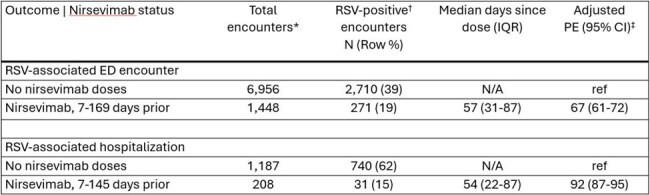 Figure 1
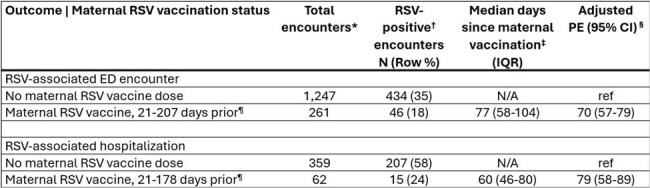 Figure 2
Peer Reviews
No public reviews on file for this paper yet. If you reviewed it on a platform where reviews are public (OpenReview, ICLR, NeurIPS, ICML), you can paste yours below so the community can read it here.
Videos
No videos yet. Explain this paper in a talk, walkthrough, or lecture? Add one.
Taxonomy
TopicsRespiratory viral infections research · COVID-19 Impact on Reproduction · Pneumonia and Respiratory Infections