P-1345. Machine Learning-driven Insights into Mortality Risk Among MRSA Bacteremia Patients on Pharmacist-led Vancomycin Dosing
Tommy Hing-cheung Tang, Kitty Tsz-ming Ng, Qianna U qing Chung, Helen Shuk-ying Chan, Sally Lok-ting Law, Vivien Wing-man Ho, Jacky Zhen-hao Goh, Man-yee Chu, Ruby Tsz-shan Kwong, Kwok-wai Lam, Wan-man Ting, Joe Lok-fung Tung, Sai-kwong Yung, Tak-chiu Wu

TL;DR
A study used machine learning to identify blood markers that predict mortality in patients with MRSA infections treated with vancomycin.
Contribution
A novel hybrid approach combining statistical tests and XGBoost machine learning identified key predictors of mortality in MRSA bacteremia patients.
Findings
A XGBoost model predicted 28-day mortality with 78.5% accuracy using six baseline variables.
Platelet count, albumin level, and blood gas pH were the top three most important predictors.
Despite individualized vancomycin dosing, 20% of MRSA bacteremia patients died within 28 days.
Abstract
Vancomycin dosing strategies guided by therapeutic drug monitoring (TDM) data are advocated in serious methicillin-resistant Staphylococcus aureus (MRSA) infections. Pharmacist-led vancomycin dosing was started in 2020 at the Queen Elizabeth Hospital (QEH), Hong Kong SAR, China. Doses were adjusted by either area under curve/minimal inhibitory concentration (AUC/MIC)-guided or trough-guided monitoring, depending on patient characteristics. This study analyzed patients with MRSA bacteremia and factors linked to mortality. It was approved by the Hospital Authority Central Institutional Review Board (CIRB-2025-019-1).Table 1.Baseline characteristics of patients with MRSA bacteremia required vancomycin therapeutic drug monitoring: at/before the first pharmacist assessment Baseline characteristics of patients with MRSA bacteremia required vancomycin therapeutic drug monitoring: at/before…
Genes, proteins, chemicals, diseases, species, mutations and cell lines named across the full text — each resolved to its canonical identifier and authoritative record.
Click any figure to enlarge with its caption.
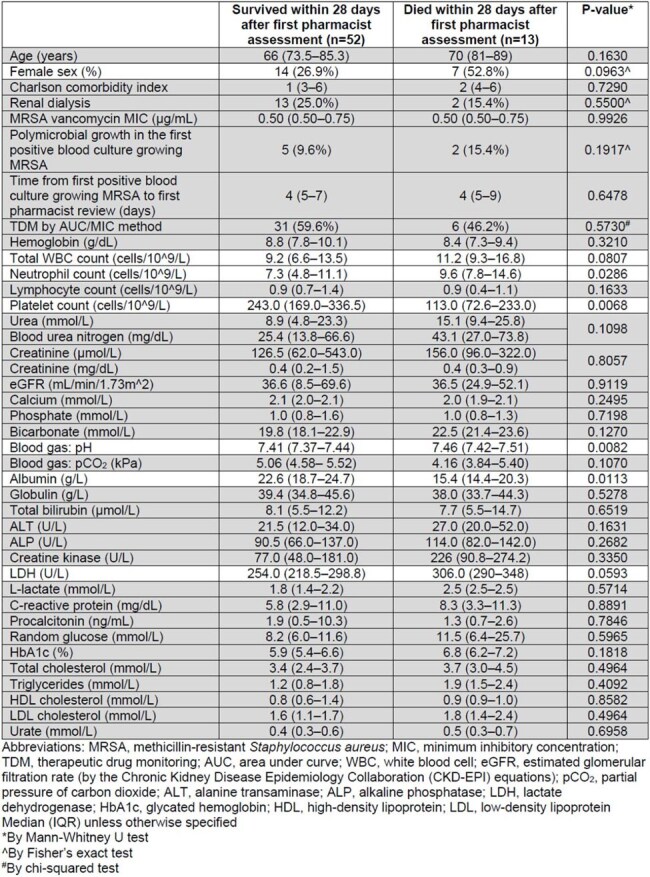 Figure 1
Peer Reviews
No public reviews on file for this paper yet. If you reviewed it on a platform where reviews are public (OpenReview, ICLR, NeurIPS, ICML), you can paste yours below so the community can read it here.
Videos
No videos yet. Explain this paper in a talk, walkthrough, or lecture? Add one.
Taxonomy
TopicsMachine Learning in Healthcare · Antimicrobial Resistance in Staphylococcus · Pharmacovigilance and Adverse Drug Reactions