190. Incidence and Risk Factors for Clostridioides difficile disease (CDI) Progression from Polymerase Chain Reaction (PCR)+/Toxin- to PCR+/Toxin+ in Patients with Cancer: a Single Center Study
Wonhee So, Maryam Jabri, Thu Phu, Justine Abella Ross, Jana Dickter, Rosemary She, Sanjeet S Dadwal

TL;DR
This study finds that cancer patients who had a positive PCR but negative toxin test for C. difficile were more likely to progress to a confirmed infection if they had undergone a specific type of stem cell transplant.
Contribution
The study identifies allogeneic hematopoietic stem cell transplant as a novel independent risk factor for progression from PCR+/toxin- to PCR+/toxin+ C. difficile in cancer patients.
Findings
8% of PCR+/toxin- patients progressed to PCR+/toxin+ C. difficile within 3 months.
Allogeneic HSCT was strongly associated with progression (OR 3.020, p < 0.001).
CDI treatment at the time of the initial test reduced the risk of progression.
Abstract
Two-step Clostridioides difficile infection (CDI) testing with PCR and EIA has improved diagnostic precision, but longitudinal significance of PCR+/toxin- (P+T-) test in immunocompromised patients is unclear. Our previous study showed P+/T- untreated patients had significantly higher P+/T+ CDI progression within 3 months compared to P+/T- patients who received CDI treatment based on signs or symptoms of CDI without alternate explanation. This study aimed to analyze the risk factors for progression over 3 months from P+/T- to a P+T+ test result. Retrospective review of adult, hospitalized patients with P+T- from 8/18/2021-8/17/2024 was performed (Figure 1). Duplicate tests ≤14 days were excluded. Patient demographics, glutamate dehydrogenase (GDH) test positivity, CDI treatment defined as receiving ≥3 days of CDI treatment at the time of index P+T- test, exposure to proton pump…
Genes, proteins, chemicals, diseases, species, mutations and cell lines named across the full text — each resolved to its canonical identifier and authoritative record.
Click any figure to enlarge with its caption.
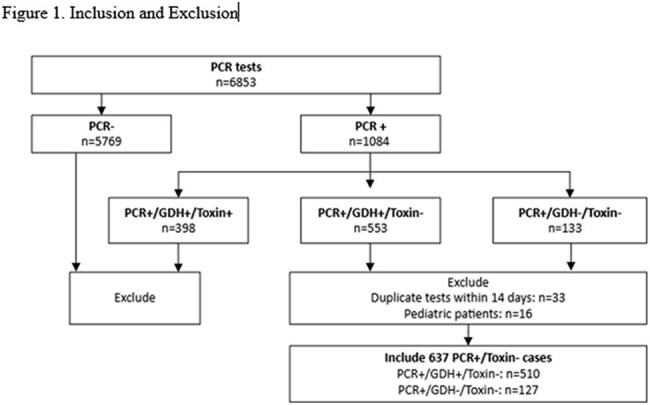 Figure 1
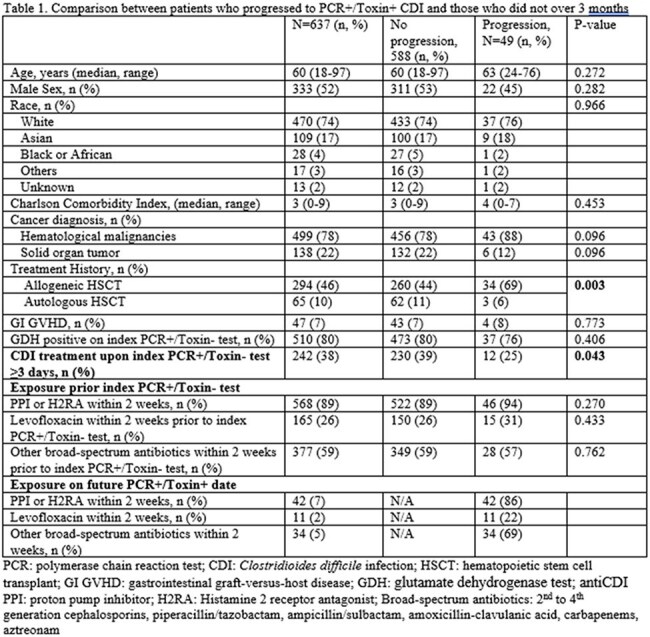 Figure 2
Peer Reviews
No public reviews on file for this paper yet. If you reviewed it on a platform where reviews are public (OpenReview, ICLR, NeurIPS, ICML), you can paste yours below so the community can read it here.
Videos
No videos yet. Explain this paper in a talk, walkthrough, or lecture? Add one.
Taxonomy
TopicsClostridium difficile and Clostridium perfringens research · Nosocomial Infections in ICU · Veterinary medicine and infectious diseases