P-234. Analyzing Robustness and Frailty: Musculoskeletal Injuries, Fractures, and Hospitalizations in U.S. Military Members with and without HIV
Brenna M Roth, Mackensie Horn, Jacqueline M Causbie, Senay Topal, Anuradha Ganesan, Daniel Clifton, Robert O’Connell, Brian Agan

TL;DR
This study examines how HIV status and frailty, as measured by the Kim Index, relate to musculoskeletal injuries, fractures, and hospitalizations among U.S. military members.
Contribution
The study applies the Kim Index to a younger, active-duty military population to assess robustness and frailty in relation to injury and hospitalization outcomes.
Findings
HIV appears to be protective against musculoskeletal injuries, possibly due to exclusion from combat roles.
Robustness, as measured by the Kim Index, is associated with lower odds of fractures and hospitalizations.
BMI and service branch are significant factors influencing injury and hospitalization risks.
Abstract
People with HIV (PWH) accumulate more comorbidities and are frailer at a younger age compared to people without HIV (PWoH). The Kim Index uses claims-based medical codes from electronic medical records to identify robustness and frailty, mostly in older people, and predict outcomes relevant to them. Musculoskeletal injuries (MSKI) and fractures are common and relevant outcomes in the active duty service member (ADSM) population. We evaluated the association of Kim Index scores with these outcomes and hospitalizations among ADSM PWH and PWoH.Table 1:Baseline characteristics of active duty service military in 2014Figure 1:Multivariate analysis of factors associated with musculoskeletal injuries, fractures, and hospitalization Baseline characteristics of active duty service military in 2014 Multivariate analysis of factors associated with musculoskeletal injuries, fractures, and…
Genes, proteins, chemicals, diseases, species, mutations and cell lines named across the full text — each resolved to its canonical identifier and authoritative record.
Click any figure to enlarge with its caption.
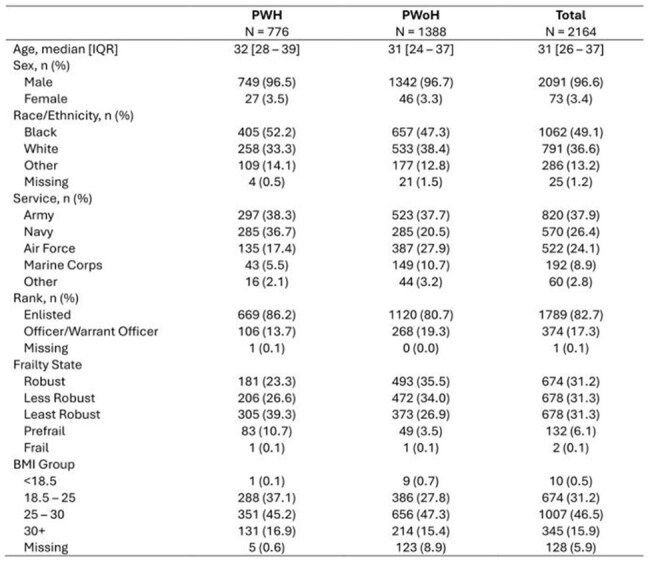 Figure 1
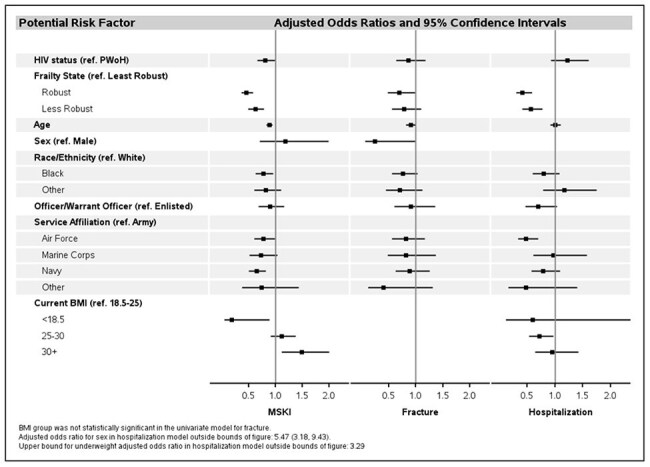 Figure 2
Peer Reviews
No public reviews on file for this paper yet. If you reviewed it on a platform where reviews are public (OpenReview, ICLR, NeurIPS, ICML), you can paste yours below so the community can read it here.
Videos
No videos yet. Explain this paper in a talk, walkthrough, or lecture? Add one.
Taxonomy
TopicsHIV-related health complications and treatments · Occupational Health and Performance · Bone and Joint Diseases