P-1428. Real-World Effectiveness of 20-Valent Pneumococcal Conjugate Vaccine among Adults 65-74, 75-84, and ≥85 Years of Age in the United States
Amanda C Miles, Lindsay Grant, Jelena Vojicic, Jeffrey T Vietri, Summer rosenstock, Huihua Li, Alison E Randall, Xin Zhao, Wencheng Zhu, Bobby Zhao, Anan Zhou, Christian Theilacker, Jennifer Moisi, Luis Jodar, Paul Palmer, Alejandro D Cane, Paula Peyrani

TL;DR
This study shows that the 20-valent pneumococcal vaccine is effective in reducing serious pneumococcal diseases in older adults, with varying effectiveness across different age groups.
Contribution
This is the first real-world study to report age-specific vaccine effectiveness of PCV20 in older adults in the US.
Findings
PCV20 showed 25.6% effectiveness against all invasive pneumococcal disease in adults ≥65 years.
Effectiveness was highest in the youngest group (65-74 years) at 35.4% and lowest in those ≥85 years at 16.6%.
The vaccine prevented 12.5 IPD and 262.0 ACP cases per 100K person-years in the overall ≥65 age group.
Abstract
The 20-valent pneumococcal conjugate vaccine (PCV20) was licensed by the FDA in 2021 for the prevention of vaccine type (VT) invasive pneumococcal disease (IPD) and pneumococcal pneumonia based on immunologic non-inferiority criteria. No clinical efficacy or vaccine effectiveness (VE) data has been reported for PCV20. The aim of this study was to evaluate age-group PCV20 VE against all IPD and all-cause pneumonia (ACP) among older adults in the US. In this retrospective time-segment design, individuals age ≥65 years were followed through the Medicare database from July 2022 to June 2024 for the first episode of all IPD (VT and non-VT) and ACP based on ICD-10-CM coding. We compared PCV20 vaccinated to unvaccinated adults with Medicare insurance for ≥1 year prior, excluding those who received 23-valent pneumococcal polysaccharide vaccine (PPSV23) < 2 years, PCV13 < 5 years, PCV20, or…
Genes, proteins, chemicals, diseases, species, mutations and cell lines named across the full text — each resolved to its canonical identifier and authoritative record.
Click any figure to enlarge with its caption.
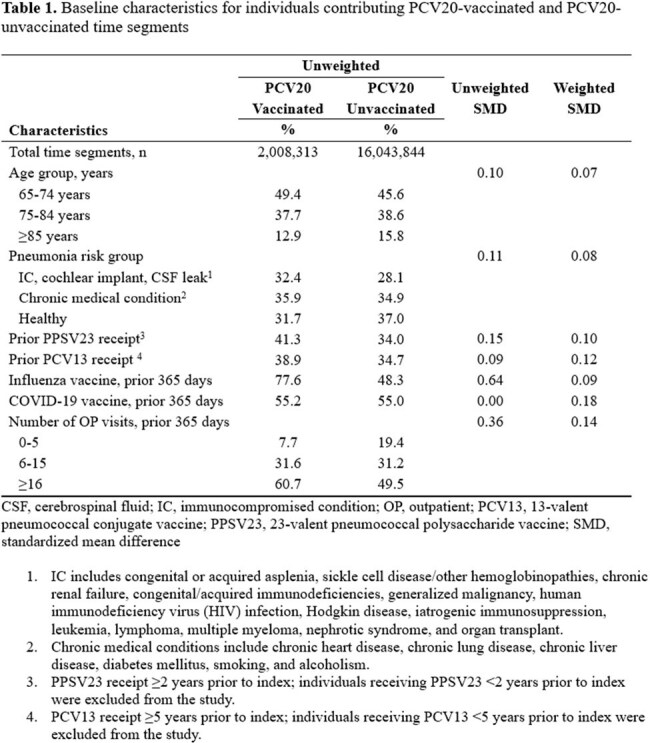 Figure 1
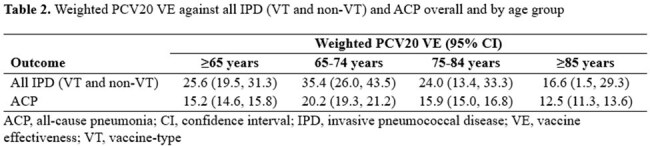 Figure 2
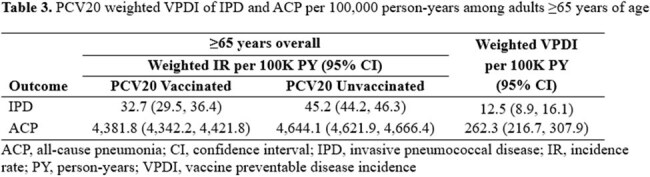 Figure 3
Peer Reviews
No public reviews on file for this paper yet. If you reviewed it on a platform where reviews are public (OpenReview, ICLR, NeurIPS, ICML), you can paste yours below so the community can read it here.
Videos
No videos yet. Explain this paper in a talk, walkthrough, or lecture? Add one.
Taxonomy
TopicsPneumonia and Respiratory Infections · Advanced Causal Inference Techniques · Respiratory viral infections research