401. Host, treatment, and disease-related risk factors for invasive fungal disease in 549 patients with newly diagnosed high-risk myeloid malignancies treated with intensive induction chemotherapy
Victor Kovac, Archana Sasi, Jessica S Little, Yiwen Liu, Ann E Woolley, Marlise Luskin, Shai Shimony, R Coleman Lindsley, Lindsey R Baden, Rahul S Vedula

TL;DR
This study identifies risk factors for invasive fungal disease in patients with high-risk myeloid malignancies undergoing intensive chemotherapy.
Contribution
The study provides an unbiased assessment of IFD risk factors in the absence of antifungal prophylaxis.
Findings
Structural lung disease, pre-chemotherapy neutropenia, and TP53 mutation were associated with increased IFD risk.
Aspergillus was the most common mold causing IFD, followed by Fusarium and Mucorales.
A targeted approach to antifungal prophylaxis may be reasonable for high-risk patients.
Abstract
Patients with acute myeloid leukemia are at the greatest risk of invasive fungal disease (IFD) of any malignancy, prompting recommendations for antifungal prophylaxis with intensive induction chemotherapy. However, this practice is not adopted at our center, permitting an unbiased assessment of host, treatment, and disease-related risk factors for IFD. Table 1.Baseline Characteristics of 549 Patients with High-Risk Myeloid Malignancies Treated with Intensive Induction Chemotherapy, Stratified by Invasive Fungal Disease Status in the First 100 Days Table 2.Proven and Probable Invasive Fungal Disease in the First 100 Days of Intensive Induction Baseline Characteristics of 549 Patients with High-Risk Myeloid Malignancies Treated with Intensive Induction Chemotherapy, Stratified by Invasive Fungal Disease Status in the First 100 Days Proven and Probable Invasive Fungal Disease in the…
Genes, proteins, chemicals, diseases, species, mutations and cell lines named across the full text — each resolved to its canonical identifier and authoritative record.
Click any figure to enlarge with its caption.
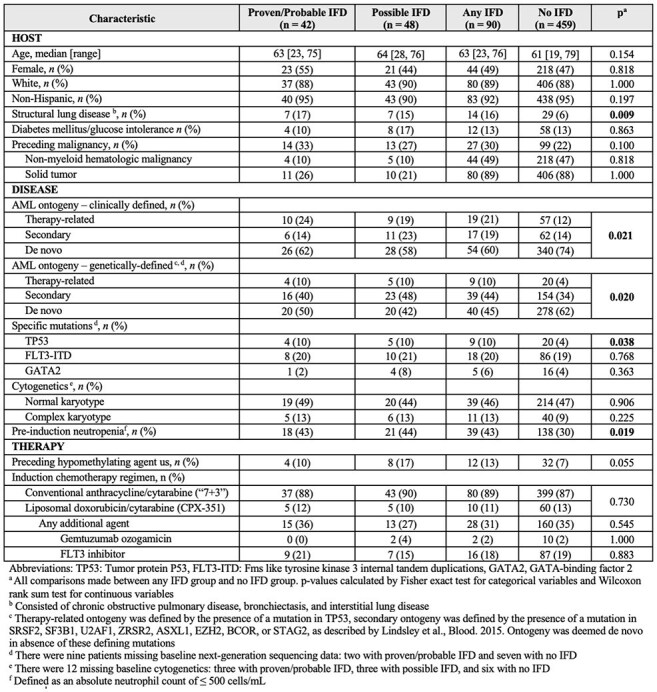 Figure 1
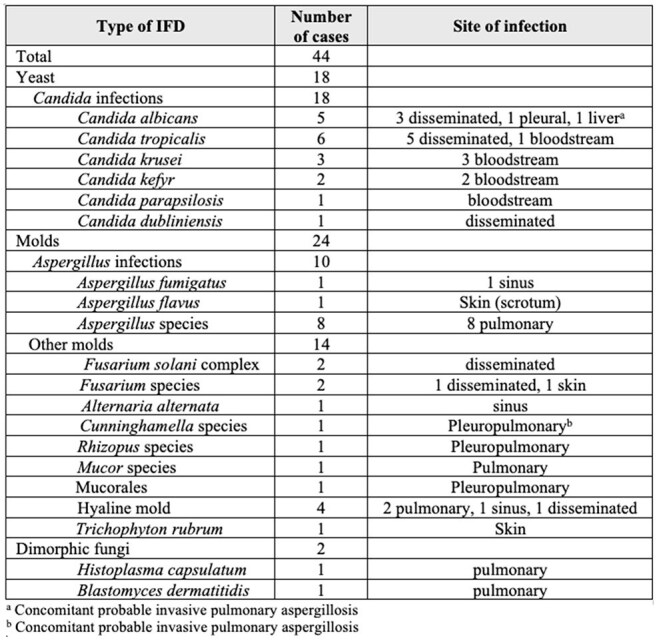 Figure 2
Peer Reviews
No public reviews on file for this paper yet. If you reviewed it on a platform where reviews are public (OpenReview, ICLR, NeurIPS, ICML), you can paste yours below so the community can read it here.
Videos
No videos yet. Explain this paper in a talk, walkthrough, or lecture? Add one.
Taxonomy
TopicsAcute Myeloid Leukemia Research · Neutropenia and Cancer Infections · Neutrophil, Myeloperoxidase and Oxidative Mechanisms