P-1674. Point of Care (POC) Molecular Diagnostics for Pharyngitis in the Urgent Care (UC): Distinct Detection Patterns in Adult and Pediatric Patients Utilizing a Point-of-Care Multiplex PCR Panel (BIOFIRE® SPOTFIRE® ST)
Alexander J Lepak, Brittany Lehrer, Shari Barlow, Maureen Goss, Caroline Hamer, Cecelia He, Emily Temte, Sarah Walters, Jonathan Temte

TL;DR
A new point-of-care test for pharyngitis shows higher detection rates in children compared to adults, with differences in pathogen types and co-infections.
Contribution
The study evaluates a novel CLIA-waived POC multiplex PCR test for pharyngitis pathogens in an urgent care setting, revealing distinct detection patterns in pediatric and adult patients.
Findings
Pediatric patients had significantly higher pathogen detection rates (85% vs. 60%) compared to adults.
Children were more likely to have Group A Streptococcus, influenza B, and M. pneumoniae infections.
Pediatric patients had higher rates of co-detections (38% vs. 7%) and treatable pathogen detections.
Abstract
Pharyngitis is one of the most common medical conditions for UC visits and can be caused by a variety of viral or bacterial pathogens. Diagnostic uncertainty can lead to provider/patient frustration and inappropriate under-/over-prescribing of antimicrobials. SPOTFIRE ST (Sore Throat) is a novel, rapid, CLIA-waived POC testing platform for 14 common bacterial and viral pathogens; however, the detection characteristics of a multi-plex PCR test in a real-world UC setting has not been evaluated fully.Figure 1.Age and Gender distribution of participants.Table 1.Pathogen Detection Results by Age Group. Age and Gender distribution of participants. Pathogen Detection Results by Age Group. This prospective study was performed during peak respiratory illness season (Dec ‘24-Mar ‘25) at a single UC center (Madison, WI). Pediatric patients (PP) with fever (1-2 y) or pharyngitis (3-17 y) and…
Genes, proteins, chemicals, diseases, species, mutations and cell lines named across the full text — each resolved to its canonical identifier and authoritative record.
Click any figure to enlarge with its caption.
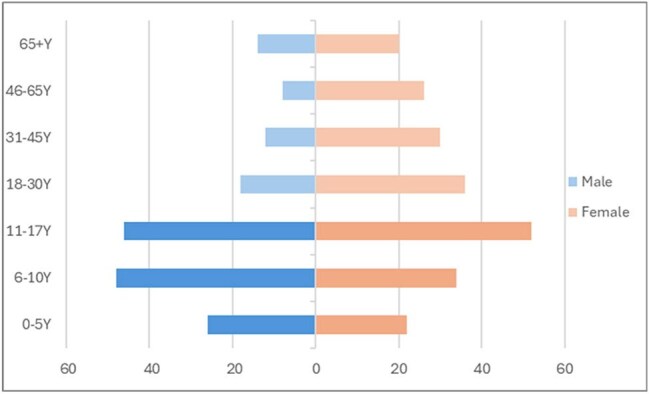 Figure 1
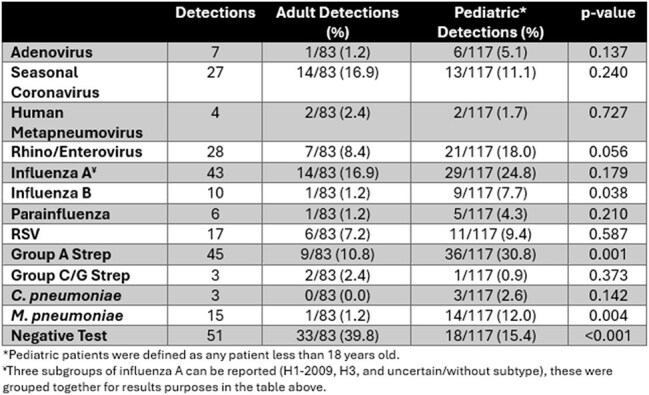 Figure 2
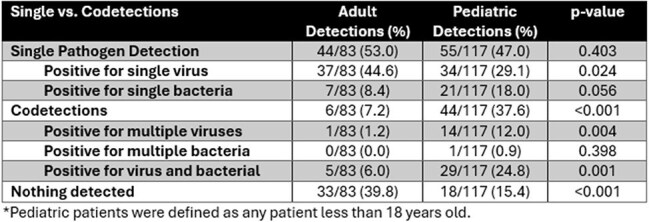 Figure 3
Peer Reviews
No public reviews on file for this paper yet. If you reviewed it on a platform where reviews are public (OpenReview, ICLR, NeurIPS, ICML), you can paste yours below so the community can read it here.
Videos
No videos yet. Explain this paper in a talk, walkthrough, or lecture? Add one.
Taxonomy
TopicsStreptococcal Infections and Treatments · Respiratory viral infections research · Pneumonia and Respiratory Infections