P-55. Clinical Outcomes Associated with Once Daily IV Metronidazole Compared to More Frequent Administrations
Rena A Nietfeld, Nick Bennett, Laura Aragon, Kensey Gosch, Sarah E Boyd

TL;DR
The study compared once-daily and more frequent IV metronidazole dosing for anaerobic bacteremia and found no significant difference in clinical outcomes.
Contribution
This study provides real-world evidence on the efficacy of once-daily IV metronidazole dosing for anaerobic bacteremia.
Findings
No significant difference in clinical failure rates between once-daily and more frequent metronidazole dosing.
ICU and hospital length of stay were similar between the two dosing groups.
Abstract
Metronidazole demonstrates concentration-dependent activity against anaerobes and is traditionally dosed intravenously (IV) at 500 mg every 8–12 hours. Its active metabolite maintains ∼60% of the parent drug’s activity and persists for 16–32 hours. Since 2009, Saint Luke’s Health System, standardized IV dosing to 1 g daily with few exceptions. Despite limited data, recent literature found 500 mg twice daily dosing was effective for anaerobic bacteremia. The purpose of this study was to compare metronidazole 1 gram IV once daily to metronidazole 500 mg IV at more frequent dosing schemes. Baseline Characteristics Baseline Characteristics Primary Outcome Primary Outcome This was a retrospective, multi-center, single health system study involving patients hospitalized between July 1, 2017, and December 31, 2024. Patients were included if they had culture confirmed anaerobic bacteremia…
Genes, proteins, chemicals, diseases, species, mutations and cell lines named across the full text — each resolved to its canonical identifier and authoritative record.
Click any figure to enlarge with its caption.
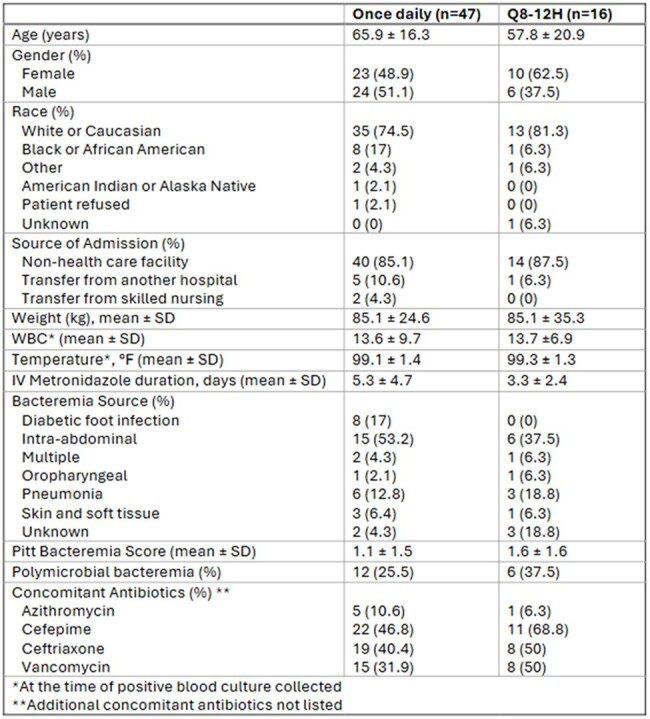 Figure 1
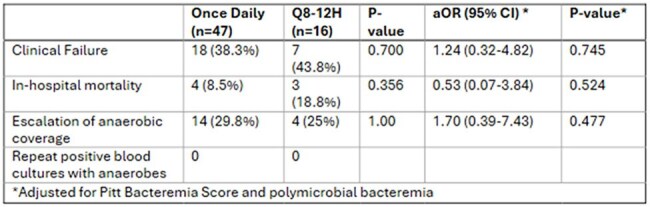 Figure 2
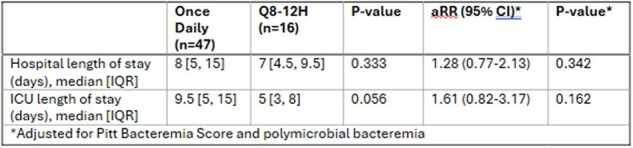 Figure 3
Peer Reviews
No public reviews on file for this paper yet. If you reviewed it on a platform where reviews are public (OpenReview, ICLR, NeurIPS, ICML), you can paste yours below so the community can read it here.
Videos
No videos yet. Explain this paper in a talk, walkthrough, or lecture? Add one.
Taxonomy
TopicsBacterial Identification and Susceptibility Testing · Antibiotic Use and Resistance · Clostridium difficile and Clostridium perfringens research