P-1203. Gepotidacin activity against Escherichia coli and Klebsiella pneumoniae, including molecularly characterized ESBL- and carbapenemase-positive subsets causing urinary tract infections in United States Medical Centers (2023)
Rodrigo E Mendes, Zachary Kockler, Gina Morgan, Renuka Kapoor, Nicole E Scangarella-Oman, S J Ryan Arends

TL;DR
This study evaluates the effectiveness of Gepotidacin, a new antibiotic, against E. coli and K. pneumoniae causing urinary tract infections in US hospitals.
Contribution
The study provides new data on Gepotidacin's activity against drug-resistant strains of E. coli and K. pneumoniae.
Findings
Gepotidacin showed high susceptibility rates against E. coli and K. pneumoniae, including resistant strains.
Gepotidacin outperformed other oral antibiotics in treating infections caused by ESBL- and carbapenemase-positive isolates.
The study benchmarks Gepotidacin's effectiveness for future monitoring after FDA approval.
Abstract
Gepotidacin (GEP) was recently approved by the United States (US) Food and Drug Administration (FDA) for the treatment of uncomplicated urinary tract infections (uUTI). GEP is a novel, bactericidal, first-in-class triazaacenaphthylene antibiotic that inhibits bacterial DNA replication by a distinct binding site, a unique mechanism of action and provides well-balanced inhibition of two type II topoisomerases (for most pathogens). This study reports the activity of GEP and other oral agents against E. coli (EC) and K. pneumoniae (KPN), including ESBL- and carbapenemase-positive isolates. 1,409 isolates from 58 US sites were included. CLSI methods were used for susceptibility testing and MIC interpretation, except for GEP that used FDA breakpoints. Isolates with aztreonam, ceftazidime, ceftriaxone or meropenem MIC of ≥2 µg/mL were sequenced, and screened for plasmid-mediated AmpC (pAmpC),…
Genes, proteins, chemicals, diseases, species, mutations and cell lines named across the full text — each resolved to its canonical identifier and authoritative record.
Click any figure to enlarge with its caption.
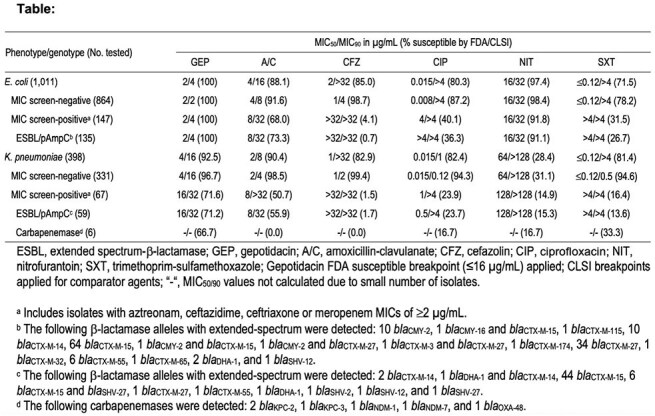 Figure 1
Peer Reviews
No public reviews on file for this paper yet. If you reviewed it on a platform where reviews are public (OpenReview, ICLR, NeurIPS, ICML), you can paste yours below so the community can read it here.
Videos
No videos yet. Explain this paper in a talk, walkthrough, or lecture? Add one.
Taxonomy
TopicsCancer therapeutics and mechanisms · Antibiotic Resistance in Bacteria · Antibiotics Pharmacokinetics and Efficacy