P-492. Immune Suppression and Anemia as Predictors of Opportunistic Infections in Children Living with HIV in the Dominican Republic
Isabel Cintron, Carmen A Duluc, Maria Laura Andino, Laura P Mendez-Reyes, Claudio Andujar, Caridad Abud, Karla Tavarez, Ana Lia Flavia, Daliah Rodriguez, Rosa Abreu, Milagros Peña, Hector Jose Lora-Rodriguez, Robert Paulino-Ramirez

TL;DR
This study examines factors like immune suppression and anemia that predict opportunistic infections in children with HIV in the Dominican Republic.
Contribution
The study identifies localized clinical predictors of opportunistic infections in children with HIV in the Dominican Republic.
Findings
Pneumonia is the most common opportunistic infection among children living with HIV in the Dominican Republic.
Lower CD4 counts and hemoglobin levels are significantly associated with the occurrence of opportunistic infections.
Most children acquired HIV through vertical transmission, and 70.89% developed at least one opportunistic infection.
Abstract
In the Dominican Republic (DR), an estimated of 810 children aged 0–14 years, were living with HIV in 2023. Opportunistic infections (OIs) remain a major contributor to morbidity among pediatric patients with HIV, yet there is a critical lack of localized research exploring the clinical and social determinants of severe infections. This study aimed to contextualize the clinical and sociodemographic factors associated with the development of OIs among children living with HIV in the DR. A retrospective cohort analysis was conducted using clinical data from 79 children living with HIV (CLHIV) who received care between 2020 and 2024 at the HIV Comprehensive Care Center of the national pediatric referral hospital. Data extracted from medical records included demographic variables, route of HIV transmission, CD4 T-cell counts, viral load (VL), and other clinical parameters. Descriptive and…
Genes, proteins, chemicals, diseases, species, mutations and cell lines named across the full text — each resolved to its canonical identifier and authoritative record.
Click any figure to enlarge with its caption.
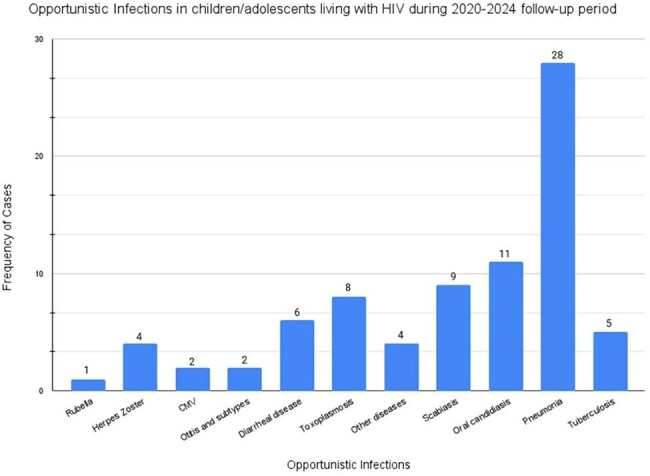 Figure 1
Peer Reviews
No public reviews on file for this paper yet. If you reviewed it on a platform where reviews are public (OpenReview, ICLR, NeurIPS, ICML), you can paste yours below so the community can read it here.
Videos
No videos yet. Explain this paper in a talk, walkthrough, or lecture? Add one.
Taxonomy
TopicsHIV/AIDS Research and Interventions · Pneumocystis jirovecii pneumonia detection and treatment · HIV/AIDS oral health manifestations