P-1757. Longitudinal Wearable Sensor Data Enhance Precision of Long COVID Detection with Machine Learning
Chibuike Uwakwe, Ekanath Rangan, Satyajit Kumar, Georg Gutjahr, Xuhui Miao, Emmy Thamakaison, Andrew Brooks, Peter Maguire, Tejaswini Mishra, Lettie McGuire, Michael Snyder

TL;DR
This study shows that combining wearable sensor data and symptom reports improves the accuracy of detecting Long COVID using machine learning models.
Contribution
The novel contribution is demonstrating that integrating heart rate and symptom data significantly enhances Long COVID detection compared to using either data type alone.
Findings
The Combined Model (RFCM) achieved a mean ROC-AUC of 0.951, significantly outperforming the Symptoms Model (0.907) and Heart Rate Model (0.748).
Using both wearable and symptom data improves Long COVID classification accuracy, suggesting a more objective diagnostic approach.
Decomposing heart rate data into complex features may enhance understanding of chronic disease physiology.
Abstract
Despite the millions of individuals struggling with persistent symptoms, Long COVID has remained difficult to diagnose due to limited objective biomarkers. Wearable devices are powerful tools for real-time health monitoring through the continuous measurement of objective physiological metrics such as heart rate (HR). Exploring physiological metrics derived from acute SARS-CoV-2 infection periods could provide actionable insights into the progression to Long COVID, ultimately informing management strategies.Model Architecture and Data FlowA schematic illustrating the processing pipeline of wearable and symptom data from individuals post-SARS-CoV-2 infection and the architecture of three models: a Random Forest Heart Rate Model (RFHRM), a Random Forest Symptoms Model (RFSM), and a Random Forest Combined Model (RFCM).Performance Evaluation of Random Forest ModelsAverage ROC curves and PR…
Genes, proteins, chemicals, diseases, species, mutations and cell lines named across the full text — each resolved to its canonical identifier and authoritative record.
Click any figure to enlarge with its caption.
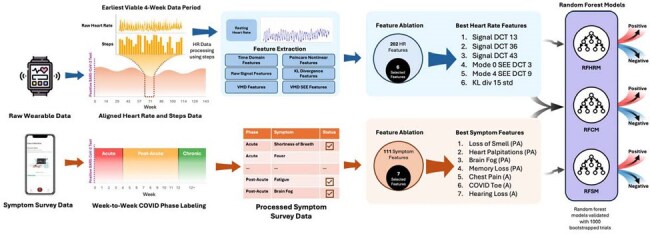 Figure 1
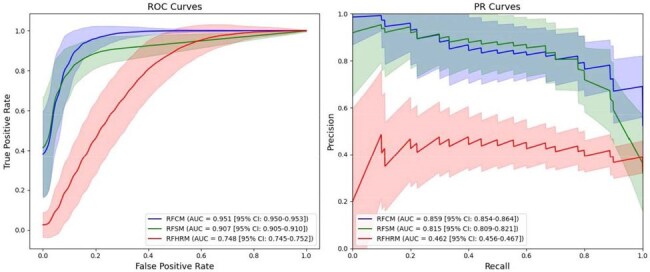 Figure 2
 Figure 3
Peer Reviews
No public reviews on file for this paper yet. If you reviewed it on a platform where reviews are public (OpenReview, ICLR, NeurIPS, ICML), you can paste yours below so the community can read it here.
Videos
No videos yet. Explain this paper in a talk, walkthrough, or lecture? Add one.
Taxonomy
TopicsNon-Invasive Vital Sign Monitoring · COVID-19 diagnosis using AI · Machine Learning in Healthcare