P-364. Efficacy and Safety by Sex Assigned at Birth After Switch to Doravirine/Islatravir (100 mg/0.25 mg) Once Daily: Week 48 Results from Two Phase 3 Randomized, Active-Controlled Studies in Adults Living with HIV-1
Princy N Kumar, Sharon Walmsley, Carolina E Chahin Anania, Eugenie Colin-Benoit, Alireza Farabi, Jaclyn Ann Bennet, Elizabeth Hellstrӧm, Alexandra Calmy, Cynthia C Brinson, Chloe Orkin, Anjana Grandhi, Monica Fuszard, Stephanie O Klopfer, Rima Lahoulou, Luisa M Stamm

TL;DR
A new HIV treatment combining doravirine and islatravir was found to be effective and safe for both men and women after one year of use.
Contribution
This study provides sex-specific efficacy and safety data for a new once-daily HIV treatment regimen.
Findings
The treatment maintained high efficacy with over 93% of participants having undetectable HIV levels at 48 weeks.
Females experienced slightly higher rates of adverse events compared to males in one study, but not in the other.
Weight changes were minimal and similar between males and females in the treatment group.
Abstract
In two Phase 3 studies, switching to doravirine/islatravir (DOR/ISL, 100 mg/0.25 mg), an investigational once-daily regimen for HIV treatment, was non-inferior for efficacy with a safety profile comparable to continuing baseline antiretroviral therapy (bART) or bictegravir/emtricitabine/tenofovir alafenamide (BIC/FTC/TAF) at Week 48 (W48). Demographic parameters might affect the efficacy or adverse event (AE) profile of an antiretroviral regimen. This subgroup analysis was performed to evaluate the efficacy and safety of DOR/ISL by sex assigned at birth. Adults with HIV-1 RNA < 50 copies/mL receiving stable oral bART (MK-8591A-051 [P051]; NCT05631093) or BIC/FTC/TAF (MK-8591A-052 [P052]; NCT05630755) for ≥3 months were randomized (2:1) to switch to DOR/ISL (100 mg/0.25 mg), or to continue bART (P051) or BIC/FTC/TAF (P052). For P051+P052, efficacy results were pooled for both the…
Genes, proteins, chemicals, diseases, species, mutations and cell lines named across the full text — each resolved to its canonical identifier and authoritative record.
Click any figure to enlarge with its caption.
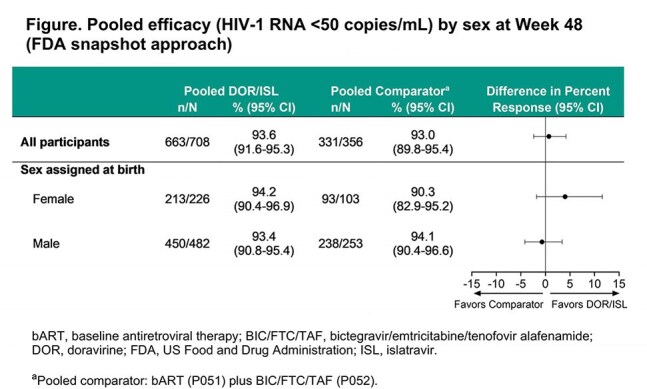 Figure 1
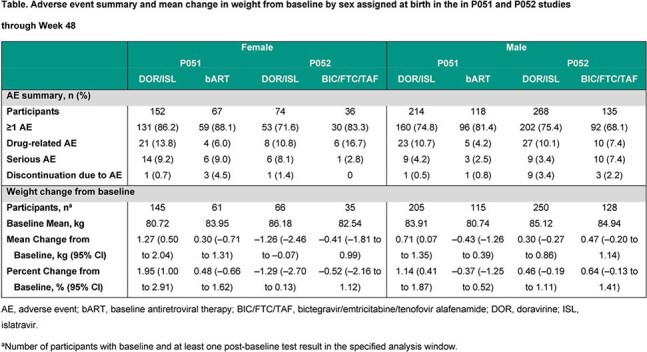 Figure 2
Peer Reviews
No public reviews on file for this paper yet. If you reviewed it on a platform where reviews are public (OpenReview, ICLR, NeurIPS, ICML), you can paste yours below so the community can read it here.
Videos
No videos yet. Explain this paper in a talk, walkthrough, or lecture? Add one.
Taxonomy
TopicsHIV/AIDS drug development and treatment · HIV/AIDS Research and Interventions · HIV-related health complications and treatments