P-1773. Intestinal Parasitic Infections in Japan: Cross-sectional Study of Prevalence and Risk Factors in Suspected Infectious Gastroenteritis
Akira Kawashima, Megumi Akashi, Yusuke Oshiro, Yasuaki Yanagawa, Rieko Shimogawara, Masami Kurokawa, Naokatsu Ando, Haruka Uemura, Takahiro Aoki, Kei Yamamoto, Junichi Akiyama, Daisuke Mizushima, Kenji Yagita, Hiroyuki Gatanaga, Koji Watanabe

TL;DR
This study examines the prevalence and risk factors of intestinal parasitic infections in Japan, finding that certain parasites are increasingly linked to sexual transmission and zoonotic spread.
Contribution
The study identifies new risk factors for intestinal parasitic infections, including sexual transmission among men who have sex with men and zoonotic transmission.
Findings
Intestinal parasitic infections were confirmed in 9.9% of 624 examined stool samples.
Domestic infections were limited to Giardia duodenalis, Entamoeba histolytica, and Cryptosporidium spp., while imported cases showed a wider variety of parasites.
Risk factors included recent travel to endemic areas, being a man who has sex with men, and animal contact.
Abstract
In developed countries, intestinal parasites are generally considered as an agent occurring among people who are traveling to or immigrants from endemic area with poor sanitation. Also, recent epidemiological studies showed that Entamoeba histolytica could happen as sexually transmitted infection (STI). However, the epidemiology of the other intestinal parasite infestations (IPIs) is still unclear in many developed countries.Figure 1.Distribution of intestinal parasites.Intestinal parasitic infections were determined by modified O&P in the present study. (A) Intestinal parasites seen in imported cases were presented, in which multiple parasites were detected from one sample in two cases. (B) Intestinal parasites seen in domestic cases are presented, in which multiple parasites are detected from one sample in four cases.Table 1.Impact of patients’ characteristics and symptoms on the…
Genes, proteins, chemicals, diseases, species, mutations and cell lines named across the full text — each resolved to its canonical identifier and authoritative record.
Click any figure to enlarge with its caption.
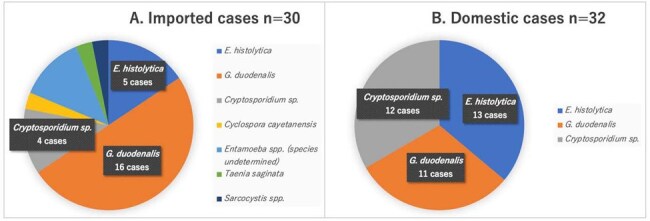 Figure 1
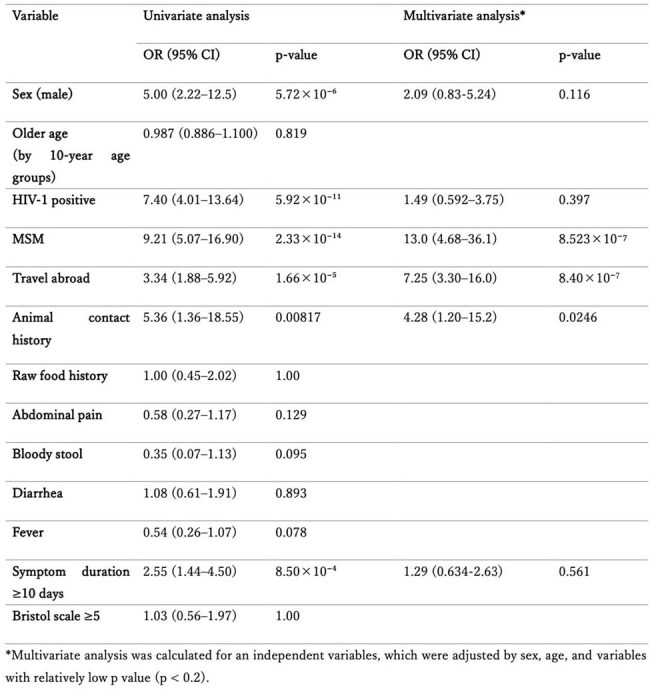 Figure 2
Peer Reviews
No public reviews on file for this paper yet. If you reviewed it on a platform where reviews are public (OpenReview, ICLR, NeurIPS, ICML), you can paste yours below so the community can read it here.
Videos
No videos yet. Explain this paper in a talk, walkthrough, or lecture? Add one.
Taxonomy
TopicsAmoebic Infections and Treatments · Parasites and Host Interactions · Parasitic Infections and Diagnostics