P-782. Developing a Multivariable Prediction Model of Antibiotic Heteroresistance to First-Line Therapies for Urinary Tract Infection
Sarah K Blaine, Sarah Lohsen, Julia A Van Riel, Madeleine Boulis, Alexandra C Rios, D’Ante Gooden, Gillian Smith, Paulina Rebolledo, Lucy S Witt, David Weiss, Sarah W Satola, Jessica Howard-Anderson

TL;DR
This study creates a model to predict antibiotic heteroresistance in urinary tract infections caused by Escherichia coli, using clinical factors like cognitive disease and age.
Contribution
A novel multivariable model using clinical risk factors to predict antibiotic heteroresistance in urinary Escherichia coli isolates.
Findings
Cognitive disease, age, and sex were significant predictors of heteroresistance in a multivariable model.
The model had modest predictive performance with an AUC of 0.64 in the main analysis and 0.69 in a subgroup analysis excluding resistant isolates.
Abstract
Heteroresistance (HR), where a subpopulation of bacteria is phenotypically resistant while most of the population appears susceptible, is not routinely tested for despite its potential association with antibiotic failure. Understanding clinical predictors of HR may improve antibiotic selection. Thus, we aimed to develop and validate a model predicting HR to oral antibiotics for urinary tract infection (UTI) in urinary Escherichia coli isolates. We analyzed urinary E. coli isolates collected during a surveillance pilot performed by the CDC-funded Georgia Emerging Infections Program. HR to nitrofurantoin, fosfomycin, or sulfamethoxazole-trimethoprim was assessed by population analysis profiling (PAP) and defined as bacterial survival >10-6 but < 50% at 1x minimum inhibitory concentration. Covariates were collected by chart review. We used logistic regression with forward selection to…
Genes, proteins, chemicals, diseases, species, mutations and cell lines named across the full text — each resolved to its canonical identifier and authoritative record.
Click any figure to enlarge with its caption.
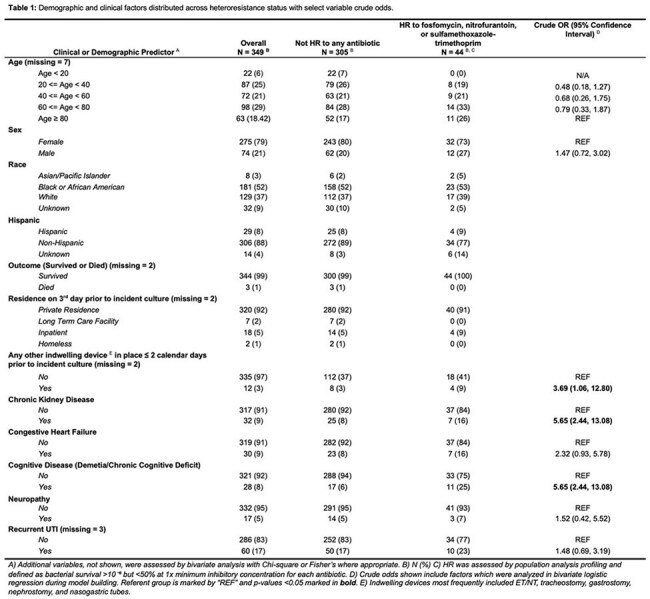 Figure 1
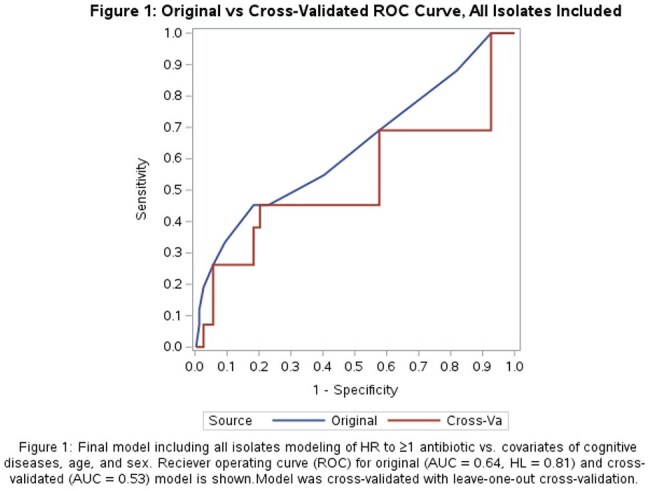 Figure 2
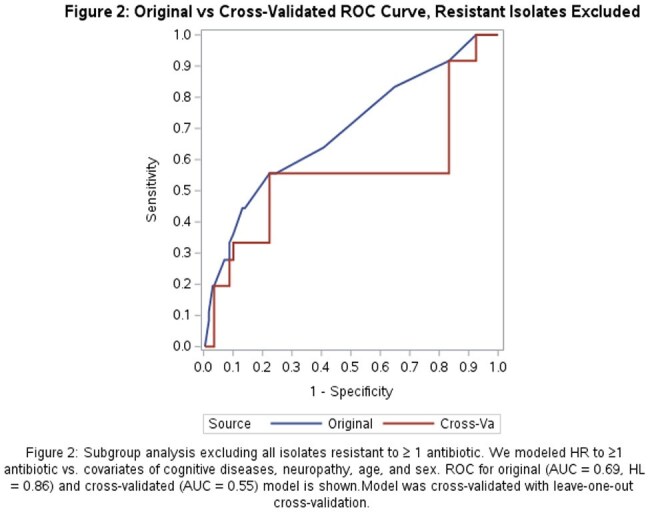 Figure 3
Peer Reviews
No public reviews on file for this paper yet. If you reviewed it on a platform where reviews are public (OpenReview, ICLR, NeurIPS, ICML), you can paste yours below so the community can read it here.
Videos
No videos yet. Explain this paper in a talk, walkthrough, or lecture? Add one.
Taxonomy
TopicsUrinary Tract Infections Management · Escherichia coli research studies · Pediatric Urology and Nephrology Studies