P-1588. Impact of the COVID-19 Pandemic on Sepsis due to Serratia: Trends in Incidence, Mortality, and Hospital Resource Utilization — A National Inpatient Sample Analysis (2016–2022)
Mohamed Barghout, Michelle Lee, Nouf K Almaghlouth

TL;DR
The study found that sepsis caused by Serratia bacteria increased in incidence and mortality during the COVID-19 pandemic, with higher healthcare costs and longer hospital stays.
Contribution
This paper is the first to analyze national trends in Serratia sepsis incidence, mortality, and healthcare utilization before and during the COVID-19 pandemic.
Findings
The incidence of Serratia sepsis increased from 13.7 to 21.0 per 100,000 hospitalizations between 2016 and 2022.
Mortality from Serratia sepsis rose significantly during the pandemic, peaking at 3.34 per 100,000 in 2021.
Patients co-infected with Serratia and COVID-19 had higher mortality, longer hospital stays, and higher charges.
Abstract
Serratia species are emerging causes of healthcare-associated sepsis, with growing concerns about antimicrobial resistance and high mortality. The influence of the coronavirus disease 2019 (COVID-19) pandemic on national trends of incidence, outcomes, and healthcare utilization in sepsis due to Serratia remains unclear.Table 1:Baseline characteristics and outcomes of patients before and during the COVID-19 era (2016–2022)Figure 1:Temporal trends in the incidence and in-hospital mortality of sepsis due to Serratia (2016–2022) Baseline characteristics and outcomes of patients before and during the COVID-19 era (2016–2022) Temporal trends in the incidence and in-hospital mortality of sepsis due to Serratia (2016–2022) We analyzed the National Inpatient Sample (NIS) from 2016 to 2022 to identify adult hospitalizations with sepsis due to Serratia and relevant comorbidities using ICD-10…
Genes, proteins, chemicals, diseases, species, mutations and cell lines named across the full text — each resolved to its canonical identifier and authoritative record.
Click any figure to enlarge with its caption.
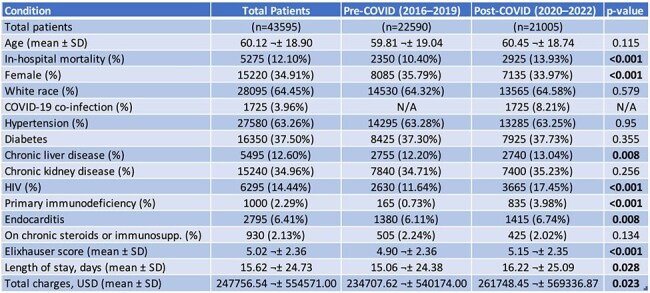 Figure 1
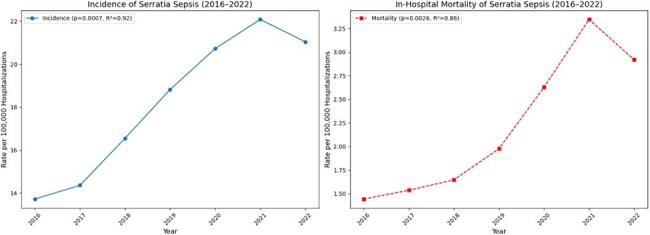 Figure 2
Peer Reviews
No public reviews on file for this paper yet. If you reviewed it on a platform where reviews are public (OpenReview, ICLR, NeurIPS, ICML), you can paste yours below so the community can read it here.
Videos
No videos yet. Explain this paper in a talk, walkthrough, or lecture? Add one.
Taxonomy
TopicsSepsis Diagnosis and Treatment · Antibiotic Resistance in Bacteria · Antibiotic Use and Resistance