P-1790. Phylogenetic Analysis, Mutation Characterization, and Comparison with Vaccine Reference Strains of Influenza HA Protein Sequences During the 2021/2022 and 2024 Seasons in Southwest Guatemala
Julio del Cid-Villatoro, Daniel Vásquez, Claudia Paiz, Kareen Arias, Neudy C Rojop, Claire Bradley, Diva M Barrientos, Molly Lamb, Beatriz Lopez, Emily Zielinski-Gutierrez, Daniel Carreon, Ashley Fowlkes, Chelsea Iwamoto, Daniel Olson

TL;DR
This study analyzed influenza virus sequences in Guatemala to compare them with vaccine strains from northern and southern hemispheres, finding that vaccine formulations may need to be tailored to local strains.
Contribution
The study provides new phylogenetic and mutation data on influenza A(H3N2) and B viruses in Guatemala, showing seasonal differences in vaccine strain alignment.
Findings
2021/2022 A(H3N2) strains showed closer amino acid similarity to northern hemisphere vaccine strains.
2024 A(H3N2) strains shared a clade with southern hemisphere vaccine strains and had a glycosylation site mutation.
Influenza B strains in both seasons matched vaccine clades.
Abstract
Background Influenza virus surface protein hemagglutinin (HA) is the primary target of antibodies that protect against influenza virus infection and disease. The viral composition of the annual influenza vaccines may differ for northern (NH) and southern (SH) hemisphere seasons. Vaccine formulation for Guatemala has fluctuated between NH and SH; some years both are used.Phylogenetic tree of influenza A H3N2 HA sequences collected in southwest Guatemala from in the 2021/2022 and 2024 seasonsInfluenza A H3 sequences were aligned along northern and southern hemisphere reference vaccine strains for the respective season. Southern hemisphere reference strain (A/Thailand/8/2022) showed the closest relationship to circulating strains.Phylogenetic tree of influenza B HA sequences collected in southwest Guatemala from in the 2021/2022 and 2024 seasonsBoth reference strains matched the…
Genes, proteins, chemicals, diseases, species, mutations and cell lines named across the full text — each resolved to its canonical identifier and authoritative record.
Click any figure to enlarge with its caption.
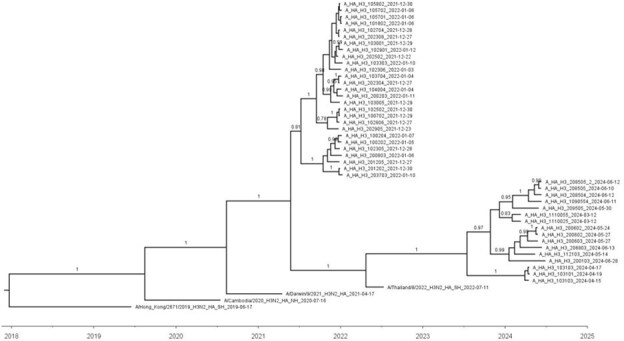 Figure 1
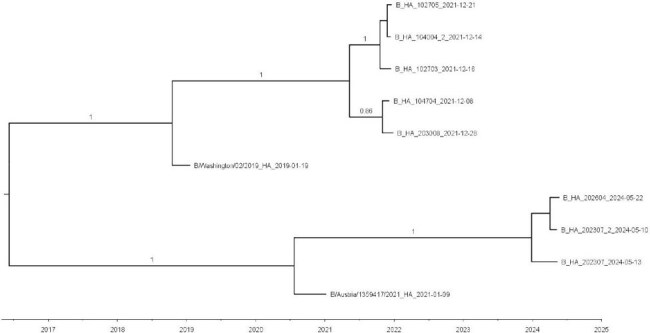 Figure 2
Peer Reviews
No public reviews on file for this paper yet. If you reviewed it on a platform where reviews are public (OpenReview, ICLR, NeurIPS, ICML), you can paste yours below so the community can read it here.
Videos
No videos yet. Explain this paper in a talk, walkthrough, or lecture? Add one.
Taxonomy
TopicsInfluenza Virus Research Studies · vaccines and immunoinformatics approaches · Poxvirus research and outbreaks