P-624. Serotyping of Streptococcus pneumoniae and Clinical Outcomes Among Hospitalized Patients in Louisville, Kentucky
Forest W Arnold, Leslie A Parrish, Subathra Marimuthu, Vidyulata Salunkhe, Daniya Sheikh, Nataly Pazmino, Jafir Wakeel, Girish Madishetty, Hamza Mehmood, Spozhmai Hewadmai, Biplab Adhikari, Hassan Cheema, Hussnain Cheema, Imad Majeed, Hamza Asif, Steven Gootee, T’shura Ali

TL;DR
The study analyzed how different Streptococcus pneumoniae serotypes affect clinical outcomes in hospitalized patients and found no significant differences in severity based on vaccine coverage.
Contribution
The study provides insights into clinical outcomes associated with PCV-20 and PCV-21 vaccine-covered Streptococcus pneumoniae serotypes in hospitalized patients.
Findings
PCV-20 serotypes showed trends toward longer hospital stays and time to stability.
PCV-21 serotypes showed trends toward higher rates of bacteremia, organ failure, and mortality.
Vaccination status among PCV-20 serotype patients did not significantly affect outcomes.
Abstract
Streptococcus pneumoniae serotypes 3, 6A, 6B, 9N and 19F often cause severe disease. The pneumococcal conjugate vaccines PCV-20 and PCV-21 cover 10 shared serotypes, along with 10 and 11 additional unique serotypes, respectively. The association between serotype coverage and severity of disease remains poorly understood. Serotype distribution of Streptococcus pneumoniae Among Hospitalized Patients This was a secondary analysis of patients with S. pneumoniae pneumonia. Serotype was determined by Quellung reaction and PCR. Demographics were collected, including vaccination status, as well as time to clinical stability, length of stay, bacteremia (invasive disease), organ failure and mortality. Patients were grouped by serotype and categorized based on PCV-20 or PCV-21 vaccine serotype. Clinical outcomes were compared between each group. For the PCV-20 serotype category, clinical…
Genes, proteins, chemicals, diseases, species, mutations and cell lines named across the full text — each resolved to its canonical identifier and authoritative record.
Click any figure to enlarge with its caption.
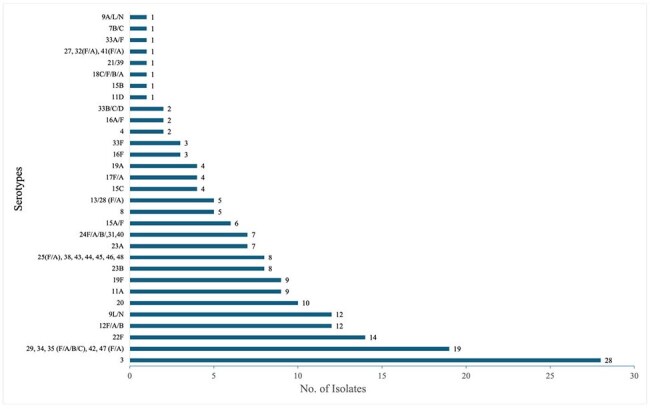 Figure 1
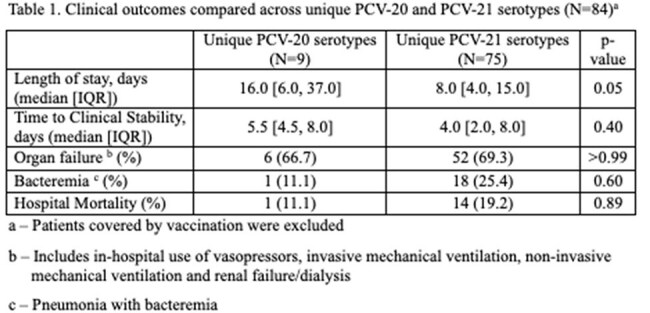 Figure 2
Peer Reviews
No public reviews on file for this paper yet. If you reviewed it on a platform where reviews are public (OpenReview, ICLR, NeurIPS, ICML), you can paste yours below so the community can read it here.
Videos
No videos yet. Explain this paper in a talk, walkthrough, or lecture? Add one.
Taxonomy
TopicsPneumonia and Respiratory Infections · Respiratory viral infections research · Advanced Causal Inference Techniques