P-595. Epidemiological characteristics and molecular investigations for human-bite ticks in Japanese spotted fever endemic areas
Shinnosuke Fukushima, Hidemasa Akazawa, Hideharu Hagiya

TL;DR
This study investigates tick bites and pathogens in Japanese spotted fever areas, finding seasonal patterns and identifying Rickettsia species in ticks.
Contribution
The study provides new epidemiological and molecular data on tick-borne pathogens in JSF endemic regions of Japan.
Findings
Amblyomma testicularis was the most common tick species found on patients, with a peak in June.
Rickettsia tamurae, R. monacensis, and an uncultured Rickettsia species were detected in ticks, but R. japonica was not.
Tick bites peaked in spring and summer, while JSF cases peaked in October, showing an epidemiological discrepancy.
Abstract
Tick-borne diseases (TBDs) have been a concern worldwide, as tick habitats and active periods are expanding due to global warming. Among TBDs, Japanese spotted fever (JSF) is the most dominant in Western Japan. However, the epidemiology of the tick species that cause tick bites or the pathogens they carry is lacking. To clarify the pathogenic microorganisms carried by ticks that bite humans and the risk of developing tick-borne infections in JSF endemic areas.Number of tick-bitten patients and Japanese spotted fever (JSF) incidence by month Number of tick-bitten patients and Japanese spotted fever (JSF) incidence by month Tick-bitten patients were most prevalent in June in this study, and the incidence of JSF in Japan was highest in October between 2016 and 2022, based on the Infectious Diseases Weekly Report. A total of 10 medical institutions in Hiroshima, Okayama, and Kagawa…
Genes, proteins, chemicals, diseases, species, mutations and cell lines named across the full text — each resolved to its canonical identifier and authoritative record.
Click any figure to enlarge with its caption.
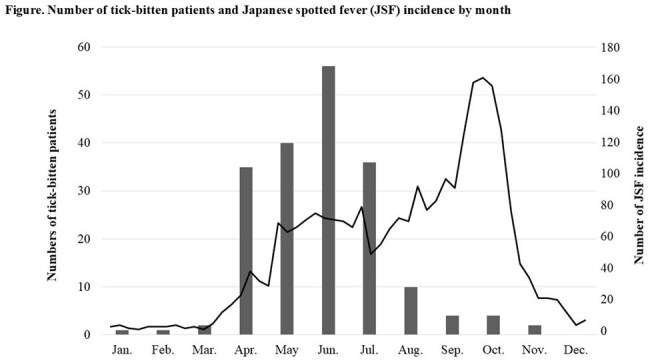 Figure 1
Peer Reviews
No public reviews on file for this paper yet. If you reviewed it on a platform where reviews are public (OpenReview, ICLR, NeurIPS, ICML), you can paste yours below so the community can read it here.
Videos
No videos yet. Explain this paper in a talk, walkthrough, or lecture? Add one.
Taxonomy
TopicsVector-borne infectious diseases · Viral Infections and Vectors · Zoonotic diseases and public health