P-599. If You’re On-time, You’re Late: Early Detection of Common Respiratory Pathogens Using Wastewater Genomic Surveillance to Shape Hospital Preparedness
Marleen M Welsh, Benjamin Knisely, Diego Insausti, Tisza A S Bell, Paige Salerno, Valerie J Morley, Dawn Gratalo, Casandra Philipson, Beth Higa Roberts, Gibran J Pierluissi-Jovet, Nora Watson, Michael Backlund, Tyler Moeller, Melissa Austin, Paige E Waterman, Wesley Campbell

TL;DR
This study shows that wastewater surveillance can help predict hospital respiratory disease trends, especially for SARS-CoV-2, up to two weeks in advance.
Contribution
The study demonstrates wastewater genomic surveillance as a predictive tool for hospital preparedness using machine learning models.
Findings
XGBoost models predicted SARS-CoV-2 with the highest accuracy (MAE: 1.9%-2.8%) across time horizons.
Wastewater data showed weak-moderate correlation with clinical outcomes for SARS-CoV-2 and flu A, but not for RSV.
More data and model optimization are needed to improve predictions for RSV and flu A.
Abstract
Wastewater (WW) surveillance (WWS) offers a promising approach to early detection of pathogens. This study explores the relationships between common respiratory viruses detected in WW and clinical laboratory data, examining whether WW pathogen changes are a leading indicator of changes in respiratory disease in hospitals. WW samples from 8 locations at Walter Reed National Military Medical Center were collected 3 times per week from October 2024 to March 2025. SARS-CoV-2, respiratory syncytial virus (RSV), and influenza (flu) A were quantified in the samples using digital polymerase chain reaction (dPCR). Daily percent positivity was calculated from de-identified WRNNMC laboratory results data, and cross-correlations between percent positivity and WW dPCR were assessed. Several modeling approaches were explored, including linear regression (lasso, ridge), tree-based methods (random…
Genes, proteins, chemicals, diseases, species, mutations and cell lines named across the full text — each resolved to its canonical identifier and authoritative record.
Click any figure to enlarge with its caption.
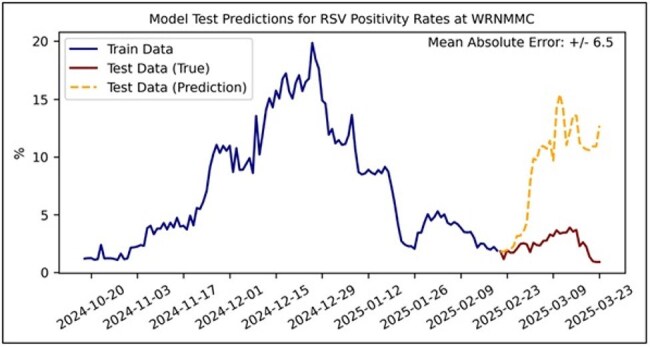 Figure 1
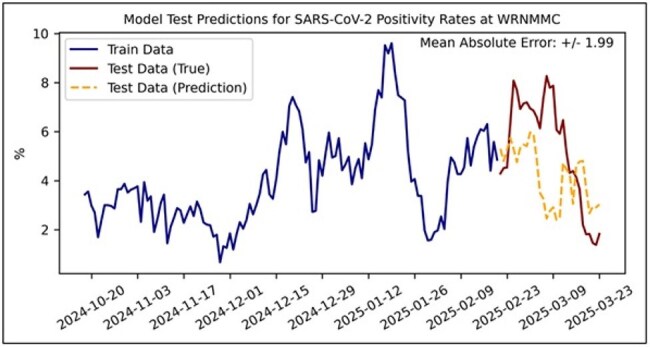 Figure 2
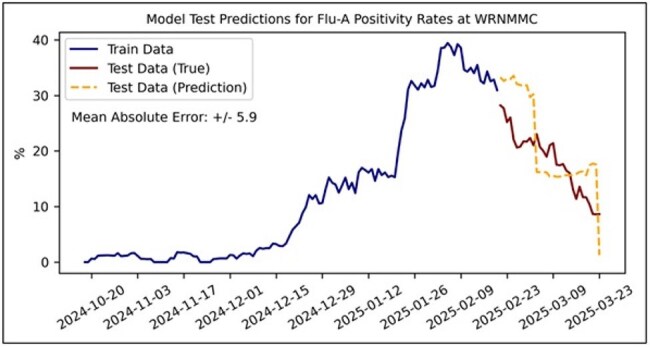 Figure 3
Peer Reviews
No public reviews on file for this paper yet. If you reviewed it on a platform where reviews are public (OpenReview, ICLR, NeurIPS, ICML), you can paste yours below so the community can read it here.
Videos
No videos yet. Explain this paper in a talk, walkthrough, or lecture? Add one.
Taxonomy
TopicsSARS-CoV-2 detection and testing · COVID-19 diagnosis using AI · Respiratory viral infections research