P-1111. An investigation of the characteristics of and measures to prevent blood-borne occupational exposure among medical staff in a tertiary general hospital
Hao Hua, Jinlan Lin, Sheng Wu

TL;DR
This study examines blood-borne occupational exposure risks among hospital staff, identifying common causes and suggesting preventive measures to improve safety.
Contribution
The study provides insights into the characteristics and prevention of blood-borne exposure in Chinese tertiary hospitals, focusing on staff demographics and protective practices.
Findings
Sharp instrument injuries were the most common cause of exposure, with needlestick injuries being predominant.
Nurses had a significantly higher exposure rate compared to doctors and support staff.
Younger and less experienced personnel were more likely to experience occupational exposure.
Abstract
Hospital workers face high risks of blood-borne occupational exposure , transmitting diseases like hepatitis and HIV. Standardized prevention effectively reduces exposure. Investigate exposure characteristics, causes, and protective measures among Chinese tertiary hospital staff through post-exposure surveys, aiming to optimize occupational safety strategies. The causes of blood-borne occupational exposure in a tertiary general hospital between December 1, 2014, and November 30, 2018 were retrospectively investigated. Data, including personnel information, incidence of occupational exposure, source of infection, and protective measures during exposure, were analyzed using SPSS 16.0. There were 102 cases of blood-borne occupational exposure in 4 years. Among these cases, 88 (86.3%) involved sharp instruments, and 14 (13.7%) involved blood and body fluids. The incidence in females…
Genes, proteins, chemicals, diseases, species, mutations and cell lines named across the full text — each resolved to its canonical identifier and authoritative record.
Click any figure to enlarge with its caption.
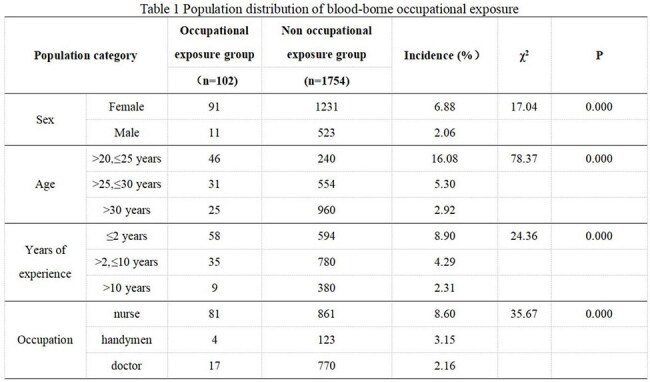 Figure 1
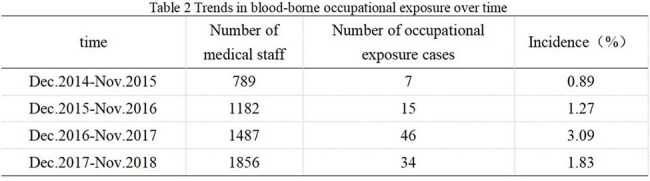 Figure 2
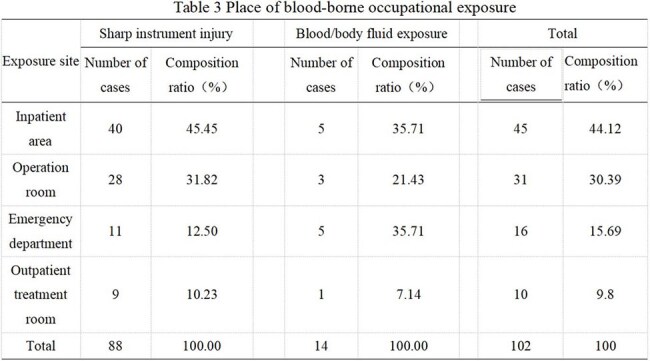 Figure 3
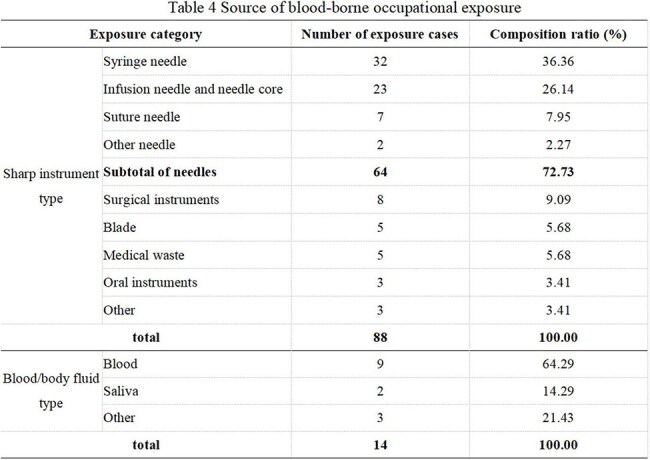 Figure 4
Peer Reviews
No public reviews on file for this paper yet. If you reviewed it on a platform where reviews are public (OpenReview, ICLR, NeurIPS, ICML), you can paste yours below so the community can read it here.
Videos
No videos yet. Explain this paper in a talk, walkthrough, or lecture? Add one.
Taxonomy
TopicsInfection Control in Healthcare · Blood donation and transfusion practices · Infection Control and Ventilation