P-1606. Clearance of Infectious Virus in COVID-19 Patients Treated with Ensitrelvir Across Vaccination Status, Age, and Risk Subgroups: Exploratory Analyses from the SCORPIO-HR Study
Florin Draica, Annie Luetkemeyer, Kara W Chew, Judith S Currier, David Smith, Simon Portsmouth, Aeron C Hurt, Takahiro Hasegawa, Safwan Kezbor, Daniel Verdi, Takeki Uehara

TL;DR
This study shows that the antiviral drug ensitrelvir helps clear infectious SARS-CoV-2 virus faster than placebo in diverse patient groups, including those with different ages, vaccination statuses, and risk levels.
Contribution
The study provides evidence that ensitrelvir accelerates infectious virus clearance across multiple subgroups, including vaccinated and unvaccinated individuals.
Findings
95.5% of ensitrelvir-treated patients achieved viral culture negativity by day 4, compared to 75.0% with placebo.
Ensitrelvir showed higher viral culture clearance in vaccinated individuals regardless of age or risk status.
Among vaccinated, standard-risk patients under 65, ensitrelvir significantly improved viral clearance compared to placebo.
Abstract
Many antiviral studies for COVID-19 have utilized molecular methods to assess viral load; however, viral RNA may remain detectable even after the infectious virus is cleared. Viral culture offers a direct measure of active viral shedding, with implications for transmission. This exploratory analysis of the phase 3 SCORPIO-HR treatment study evaluated the effect of ensitrelvir versus placebo on the clearance of infectious virus on day 4 in patients with baseline positive viral culture, stratified by risk status for severe COVID-19 (high risk, standard risk), age (< 65 years, ≥ 65 years), and COVID-19 vaccination status (vaccinated, unvaccinated) (Table 1). Viral culture data in these subgroups are presented for ensitrelvir- versus placebo-treated patients. The endpoint in this exploratory analysis was the proportion of participants with negative SARS-CoV-2 viral culture on day 4. Among…
Genes, proteins, chemicals, diseases, species, mutations and cell lines named across the full text — each resolved to its canonical identifier and authoritative record.
Click any figure to enlarge with its caption.
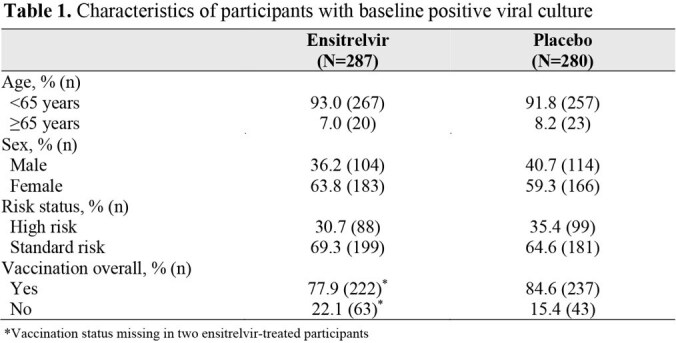 Figure 1
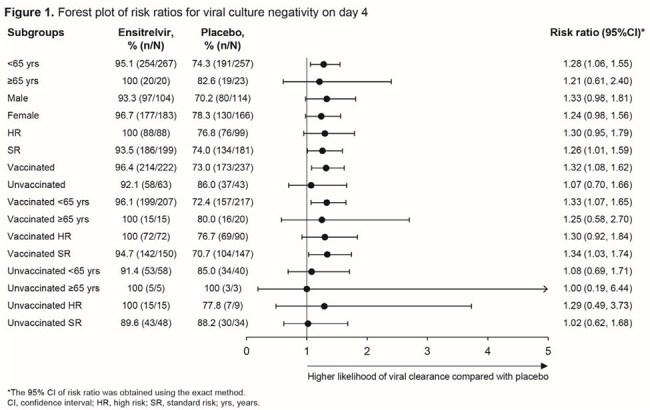 Figure 2
Peer Reviews
No public reviews on file for this paper yet. If you reviewed it on a platform where reviews are public (OpenReview, ICLR, NeurIPS, ICML), you can paste yours below so the community can read it here.
Videos
No videos yet. Explain this paper in a talk, walkthrough, or lecture? Add one.
Taxonomy
TopicsSARS-CoV-2 and COVID-19 Research · COVID-19 Clinical Research Studies · Respiratory viral infections research