180. Durability of Antibody Response to RSV Vaccination in Immunocompromised Individuals
Zeba Nauroz, Camille Hage, Isabella Sengsouk, Prasanthy Balasubramanian, Xori Green, Woudase Gallo, Jiashu Xue, Maggie Chahoud, Aaron Tobian, William Werbel, Andrew H Karaba

TL;DR
This study examines how long antibody responses last in immunocompromised individuals after RSV vaccination, finding that many never reach protective levels.
Contribution
The study provides the first data on antibody durability in immunocompromised individuals following RSV vaccination.
Findings
Median anti-RSV preF IgG levels peaked at 12 weeks post-vaccination and remained relatively stable for 6 months.
Only 37% of participants achieved high-titer antibody responses at 4 weeks, with no significant increase beyond 6 months.
RSV-AS01E vaccine induced higher antibody and neutralizing responses compared to RSV-A/B at multiple time points.
Abstract
Immunocompromised persons (ISPs) demonstrate attenuated antibody responses to respiratory syncytial virus (RSV) vaccination. In healthy populations, antibody (Ab) response and clinical protection last for >1 year following a single vaccine dose, yet Ab durability in ISPs has not been established.Figure 1.Anti-RSV preF IgG After Vaccination Over Time. Anti-RSV preF IgG After Vaccination Over Time. Total anti-RSV preF specific IgG (Arbitrary Units[AU]/mL) at baseline and the indicated number of weeks (W) after RSV vaccination. Each dot represents an individual sample. Dots are colored by vaccine type (Orange = RSV-AS01E, Blue = RSV A/B). Red horizontal line represents preF IgG value of high-titer pre-vaccine era control plasma from BEI resources. Fractions below the boxplots represent the participants from each vaccine type with high titer response over total recipients of that vaccine…
Genes, proteins, chemicals, diseases, species, mutations and cell lines named across the full text — each resolved to its canonical identifier and authoritative record.
Click any figure to enlarge with its caption.
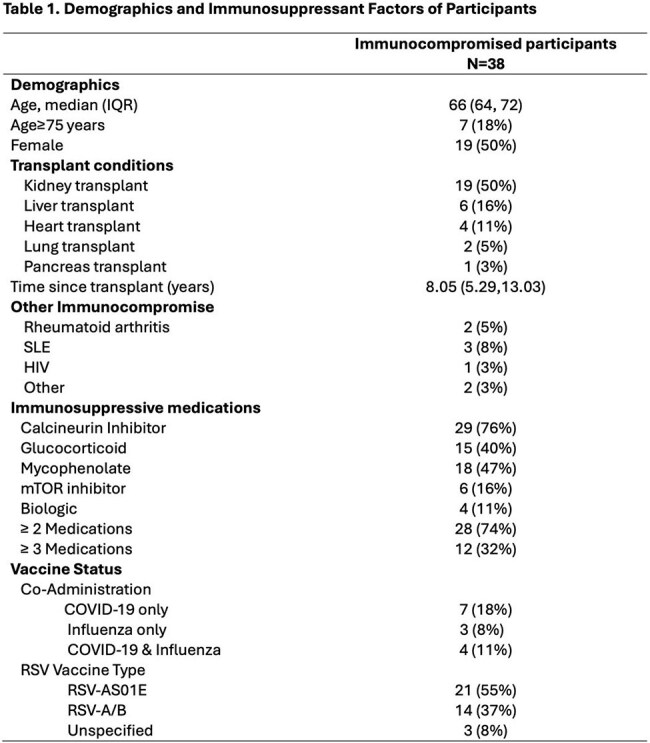 Figure 1
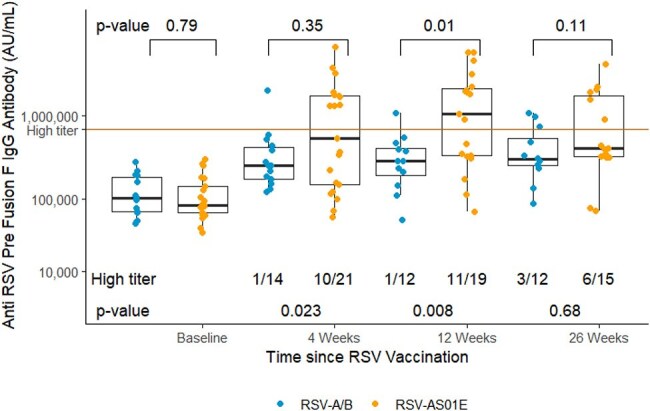 Figure 2
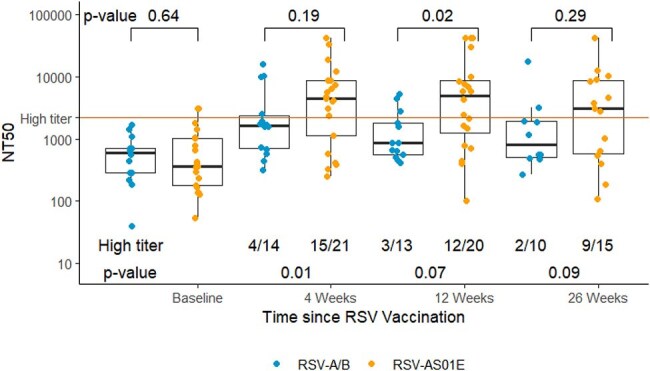 Figure 3
Peer Reviews
No public reviews on file for this paper yet. If you reviewed it on a platform where reviews are public (OpenReview, ICLR, NeurIPS, ICML), you can paste yours below so the community can read it here.
Videos
No videos yet. Explain this paper in a talk, walkthrough, or lecture? Add one.
Taxonomy
TopicsRespiratory viral infections research · Advanced Biosensing Techniques and Applications · SARS-CoV-2 detection and testing