P-1571. Variability in Case-Ascertainment Methodology and Rates of Adult Invasive Pneumococcal Disease using a US Healthcare Claims Database
Ahuva Averin, Mark Rozenbaum, Stephen I Pelton, Rotem Lapidot, Amanda C Miles, Lindsay Grant, Alexander Lonshteyn, Maria J Tort, Jeffrey T Vietri, Derek Weycker

TL;DR
This study shows how different methods for identifying cases of invasive pneumococcal disease in healthcare claims data can lead to large differences in disease rate estimates.
Contribution
The study demonstrates significant variability in IPD rates based on case-ascertainment methodology using a US healthcare claims database.
Findings
Hospitalized IPD rates were 37-43% higher when including non-facility claims during admission.
Ambulatory IPD rates were 67-174% higher when using a single claim with diagnostic evidence versus stricter criteria.
Variability in case-ascertainment methods can lead to large differences in disease rate estimates from healthcare claims data.
Abstract
Healthcare claims databases are commonly employed to evaluate the epidemiology, outcomes, and costs of disease. However, validated case-ascertainment methods are largely unavailable, and thus outcome definitions often differ in terms of codes, algorithms, and/or data fields used to identify patients with a given disease; consequently, findings across studies often vary. In this study, we explored—as an exemplar—the impact of alternative case-ascertainment methods on variability in rates of adult invasive pneumococcal disease (IPD). A retrospective cohort design and the Optum Clinformatics DataMart (CDM; 2016-2019) were employed; the Optum CDM includes healthcare claims from a large commercial health plan in the United States. From the study population comprising adults aged ≥ 18 years, patients with IPD requiring hospitalization or ambulatory care only were identified using several…
Genes, proteins, chemicals, diseases, species, mutations and cell lines named across the full text — each resolved to its canonical identifier and authoritative record.
Click any figure to enlarge with its caption.
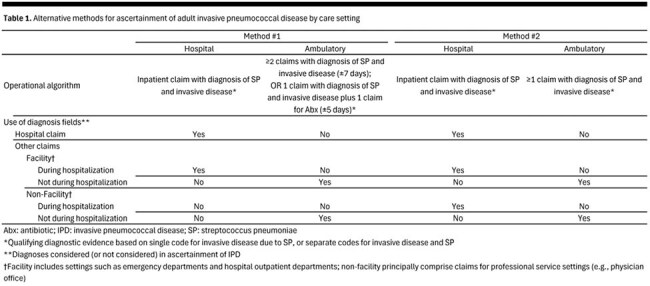 Figure 1
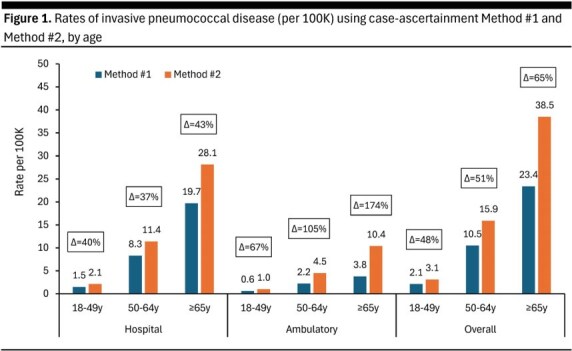 Figure 2
Peer Reviews
No public reviews on file for this paper yet. If you reviewed it on a platform where reviews are public (OpenReview, ICLR, NeurIPS, ICML), you can paste yours below so the community can read it here.
Videos
No videos yet. Explain this paper in a talk, walkthrough, or lecture? Add one.
Taxonomy
TopicsPneumonia and Respiratory Infections · Advanced Causal Inference Techniques · Machine Learning in Healthcare