P-1003. Evolutionary Differences within the Epidemic Clostridioides difficile Strain Identified as PCR-Ribotype 027
Andrew M Skinner, Laurica A Petrella, Jennifer Cadnum, Adam K Cheknis, Munok Hwang, Hosoon Choi, Charlesnika T Evans, Chetan Jinadatha, Larry K Kociolek, Curtis Donskey, Dale N Gerding, Matthew H Samore, Stuart Johnson

TL;DR
This study tracks the evolution of a Clostridioides difficile strain over 40 years, showing increasing antibiotic resistance and genetic mutations.
Contribution
The study provides new insights into the genetic and antimicrobial resistance evolution of the C. difficile RT027 strain over decades.
Findings
MICs for several antibiotics increased significantly in RT027 isolates over 40 years.
Fluoroquinolone resistance mutations emerged in the 2000s but were absent in earlier isolates.
Recent isolates showed rpoB mutations linked to resistance to fidaxomicin.
Abstract
In the early 2000s, the epidemic strain identified as PCR Ribotype 027 (RT027) and multilocus sequence type (MLST) 1 was the dominant strain group accounting for >70% of CDI in some institutions. Notably, the strain group was fluroquinolone resistant (FQR) which likely contributed to the spread of the group strain. However, there is a paucity of data comparing historic clinical isolates prior to the spread of the epidemic strain.Table 1.Minimum Inhibitory Concentration for 10 antibiotics for 91 isolates identified at PCR-RT 027MIC: Minimum Inhibitory Concentration; RT: RibotypeFigure 1.Bayesian time scale phylogenetic analysis with minimum inhibitory concentration changes Minimum Inhibitory Concentration for 10 antibiotics for 91 isolates identified at PCR-RT 027 MIC: Minimum Inhibitory Concentration; RT: Ribotype Bayesian time scale phylogenetic analysis with minimum inhibitory…
Genes, proteins, chemicals, diseases, species, mutations and cell lines named across the full text — each resolved to its canonical identifier and authoritative record.
Click any figure to enlarge with its caption.
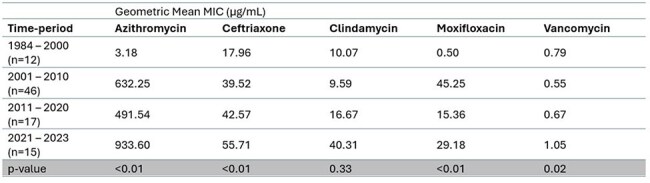 Figure 1
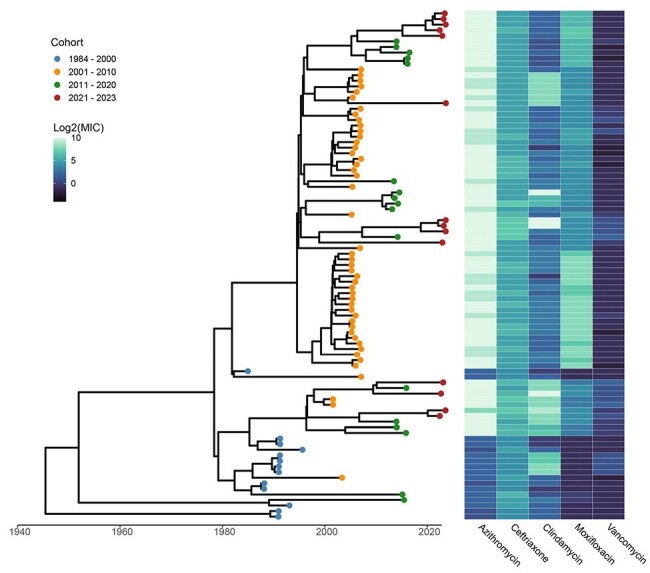 Figure 2
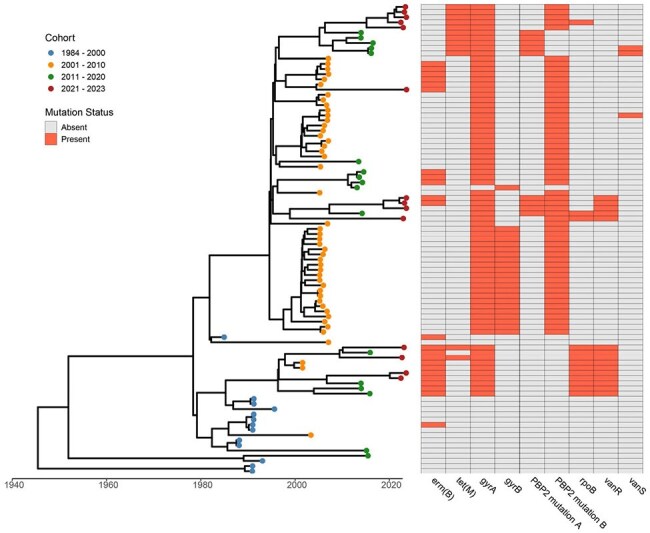 Figure 3
Peer Reviews
No public reviews on file for this paper yet. If you reviewed it on a platform where reviews are public (OpenReview, ICLR, NeurIPS, ICML), you can paste yours below so the community can read it here.
Videos
No videos yet. Explain this paper in a talk, walkthrough, or lecture? Add one.
Taxonomy
TopicsClostridium difficile and Clostridium perfringens research · Antimicrobial Resistance in Staphylococcus · Antibiotic Use and Resistance