564. Nirsevimab effectiveness in infants against respiratory syncytial virus (RSV) lower respiratory tract disease (LRTD) and related healthcare utilization
Amber Hsiao, John R Hansen, Julius Timbol, Lauren D Liao, Bruce Fireman, Ousseny Zerbo, Karine Mari, Christopher Rizzo, William V La Via, Ruvim Izikson, Nicola P Klein

TL;DR
Nirsevimab, a new monoclonal antibody, significantly reduced RSV-related lower respiratory tract disease and healthcare visits in infants during its first season of use.
Contribution
This study provides real-world evidence of nirsevimab's effectiveness in reducing RSV LRTD and associated healthcare utilization in infants.
Findings
RSV LRTD incidence was 6.1 per 1,000 person-years in nirsevimab-immunized infants versus 58.5 in non-immunized infants.
Nirsevimab-immunized infants had significantly lower rates of antibiotic prescriptions and encounters for respiratory diagnoses.
The observed RSV LRTD incidence in 2023-2024 was much lower than in pre-nirsevimab years.
Abstract
Respiratory syncytial virus (RSV) is the most common cause of lower respiratory tract disease (LRTD) in infants and young children. In 2023, the monoclonal antibody nirsevimab was FDA approved. ACIP recommends nirsevimab to prevent RSV disease for infants < 8 months during or entering their first RSV season, and for children 8-19 months at high risk of severe RSV entering their second RSV season. We previously reported that nirsevimab was 87.2% effective against RSV LRTD in infants. Here, we describe RSV LRTD incidence since 2016 and report on nirsevimab effectiveness against related healthcare utilization. We included nirsevimab-eligible, healthy term infants born April 2023 to April 2024 at Kaiser Permanente Northern California. RSV LRTD incidence in all healthcare settings among nirsevimab-immunized and non-immunized infants was compared with incidence among healthy term infants…
Genes, proteins, chemicals, diseases, species, mutations and cell lines named across the full text — each resolved to its canonical identifier and authoritative record.
Click any figure to enlarge with its caption.
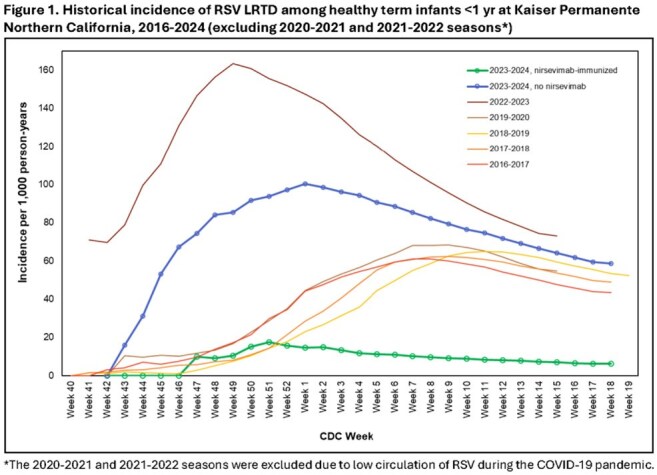 Figure 1
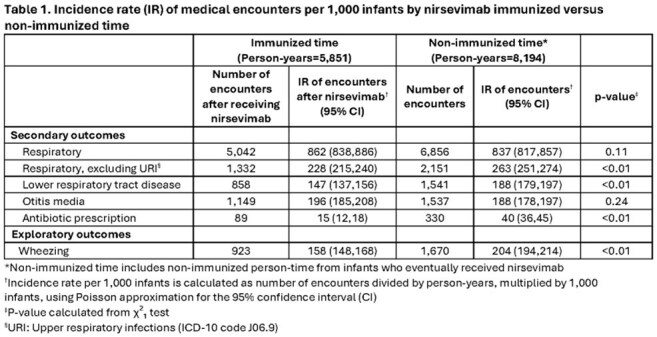 Figure 2
Peer Reviews
No public reviews on file for this paper yet. If you reviewed it on a platform where reviews are public (OpenReview, ICLR, NeurIPS, ICML), you can paste yours below so the community can read it here.
Videos
No videos yet. Explain this paper in a talk, walkthrough, or lecture? Add one.
Taxonomy
TopicsRespiratory viral infections research · Pneumonia and Respiratory Infections · Immunodeficiency and Autoimmune Disorders