P-1502. Barriers and Enablers for Tdap Vaccination Among Pregnant Women Attending Antenatal Clinics in a Tertiary Hospital
Jomel Raju, Leena James, Maria Tom

TL;DR
This study explores why some pregnant women in India don't get the Tdap vaccine and what can encourage them to do so.
Contribution
The study identifies specific behavioral and systemic barriers and enablers to Tdap vaccination uptake in a South Indian hospital.
Findings
Only 36.9% of eligible pregnant women received the Tdap vaccine.
Lack of awareness (48.2%) and fear of side effects (27.5%) were major barriers.
Provider endorsement significantly increased vaccination uptake (aOR: 3.8).
Abstract
Vaccination with tetanus, diphtheria, and acellular pertussis (Tdap) during pregnancy is a proven strategy to prevent neonatal pertussis-related morbidity and mortality. However, in India, Tdap vaccination uptake during pregnancy remains low, with limited research on the behavioral and systemic barriers. This study aimed to evaluate the barriers and facilitators influencing Tdap vaccination among pregnant women attending antenatal care (ANC) in a tertiary care hospital in South India.Barriers and Enablers for Tdap Vaccination Among Pregnant WomenThis chart visualizes the key barriers (in red) and enablers (in green) influencing Tdap vaccination uptake among pregnant women in a tertiary care hospital in South India. Barriers include lack of awareness (48.2%), fear of side effects (27.5%), and absence of provider recommendation (22.3%). Enablers such as provider endorsement (aOR: 3.8),…
Click any figure to enlarge with its caption.
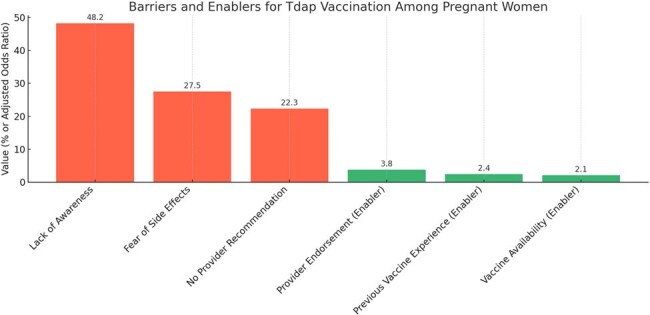 Figure 1
Peer Reviews
No public reviews on file for this paper yet. If you reviewed it on a platform where reviews are public (OpenReview, ICLR, NeurIPS, ICML), you can paste yours below so the community can read it here.
Videos
No videos yet. Explain this paper in a talk, walkthrough, or lecture? Add one.
Taxonomy
TopicsBacterial Infections and Vaccines · Vaccine Coverage and Hesitancy · Immune responses and vaccinations