P-1189. In Vitro Interaction Between Amphotericin B and Oteseconazole: Exploring the Potential for Combination Therapy for Talaromycosis
Heera Natesan Sambath, Matthew Burke, Thi Mai Thu Nguyen, Emily Evans, Thi Hoa Ngo, Thuy Le

TL;DR
This study explores combining amphotericin B and oteseconazole to treat talaromycosis, finding partial synergy in most cases.
Contribution
The study is the first to investigate the in vitro drug interaction between amphotericin B and oteseconazole for talaromycosis.
Findings
Combining amphotericin B and oteseconazole showed a 4-fold reduction in minimum inhibitory concentration in 77% of isolates.
The combination demonstrated partial synergy in most cases and no antagonism in time-kill assays.
Oteseconazole's long half-life and safety profile make it a promising candidate for prolonged therapy.
Abstract
The mortality due to talaromycosis is up to 30% despite standard amphotericin B (AmB) therapy. While combination antifungal therapy has proven benefits in other mycoses, evidence for talaromycosis is lacking. Oteseconazole (OTZ), a newly FDA-approved azole, has low MIC against Talaromyces marneffei (Tm), a half-life of 20 weeks, a good safety profile, and is not metabolized by human cytochrome P450, collectively making it an exciting choice for prolonged consolidation and maintenance therapy for talaromycosis while minimizing drug interactions seen with current azoles.Figure 1:Drug-drug interaction between amphotericin B (AmB) and oteseconazole (OTZ) against Talaromyces marneffei assessed using the checkerboard assay.The 96-well plate contains 2-fold serial dilutions of AmB (2 to 0.03 µg/mL) and OTZ (0.25 to 0.0005 µg/mL). Positive control (pink, well A1) contains only Talaromyces…
Genes, proteins, chemicals, diseases, species, mutations and cell lines named across the full text — each resolved to its canonical identifier and authoritative record.
Click any figure to enlarge with its caption.
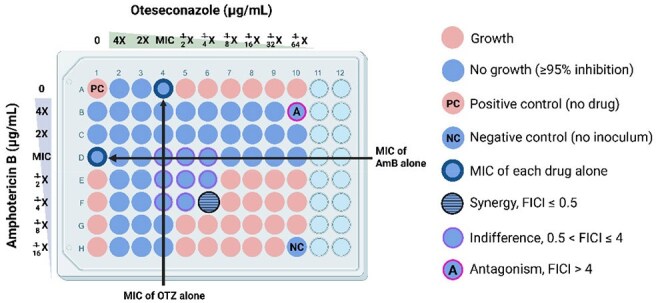 Figure 1
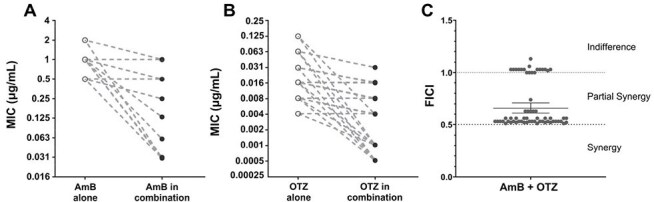 Figure 2
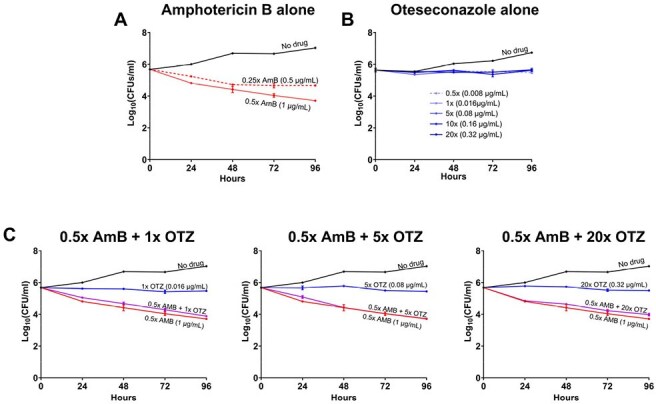 Figure 3
Peer Reviews
No public reviews on file for this paper yet. If you reviewed it on a platform where reviews are public (OpenReview, ICLR, NeurIPS, ICML), you can paste yours below so the community can read it here.
Videos
No videos yet. Explain this paper in a talk, walkthrough, or lecture? Add one.
Taxonomy
TopicsAntifungal resistance and susceptibility · Fungal Infections and Studies · Infectious Diseases and Mycology