P-102. Changes in immunologic parameters following the addition of fostemsavir in virally suppressed immune non-responders living with HIV-the RECOVER study
Charlotte-Paige M Rolle, Jamie Castano, Vu Nguyen, Federico Hinestrosa, Edwin DeJesus

TL;DR
Adding fostemsavir to existing HIV treatments significantly boosts CD4+ T-cell counts in patients who haven't responded well to standard therapy.
Contribution
This study shows fostemsavir improves immune recovery in HIV patients who are virally suppressed but have low CD4+ T-cell counts.
Findings
CD4+ T-cell counts increased significantly by 40 cells/mm³ (mean) and 32 cells/mm³ (median) after 48 weeks of fostemsavir addition.
24% of participants achieved a CD4+ T-cell count of ≥350 cells/mm³ by Week 48.
No serious drug-related adverse events were reported, and most participants remained on the treatment.
Abstract
Fostemsavir (FTR) is a pre-attachment inhibitor that binds directly to viral gp120 preventing HIV interaction with the host immune cell. This unique mechanism may drive the robust CD4+ T-cell recovery seen in the BRIGHTE study. Here, we evaluate changes in immunologic parameters following addition of FTR to antiretroviral (ARV) regimens among virally suppressed immune non-responders (INRs) through 48 weeks. RECOVER (NCT05220358) is an ongoing, open-label clinical trial that enrolled adult INRs defined as those with HIV-1 RNA<50 copies/mL and CD4+ T-cell count< 350 cells/mm3 while on suppressive ARVs for ≥2 years. Participants added FTR to their baseline ARV regimen and were followed for 48 weeks. Co-primary endpoints are mean and median change in CD4+ T-cell count at Week 48 using pre-FTR mean and median CD4+ T-cell counts 96 weeks prior to study entry as controls. 48-week data from…
Genes, proteins, chemicals, diseases, species, mutations and cell lines named across the full text — each resolved to its canonical identifier and authoritative record.
Click any figure to enlarge with its caption.
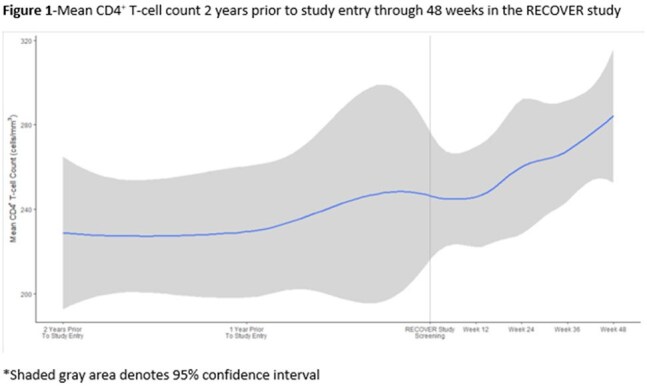 Figure 1
Peer Reviews
No public reviews on file for this paper yet. If you reviewed it on a platform where reviews are public (OpenReview, ICLR, NeurIPS, ICML), you can paste yours below so the community can read it here.
Videos
No videos yet. Explain this paper in a talk, walkthrough, or lecture? Add one.
Taxonomy
TopicsHIV Research and Treatment · HIV/AIDS Research and Interventions · HIV/AIDS drug development and treatment