P-1281. Genomic and Transcriptional Adaptations in a Spontaneous Cefiderocol-Resistant Klebsiella pneumoniae KPC-Producing Mutant Isolate
Irene Luu, Vyanka Mezcord, Jenny Escalante, German Traglia, Marisel Tuttobene, Cecilia Rodriguez, Marcelo Tolmasky, Robert A Bonomo, Gauri G Rao, Fernando Pasteran, Maria Soledad Ramirez

TL;DR
This study explores how a Klebsiella pneumoniae strain becomes resistant to cefiderocol, a last-line antibiotic, and reveals genetic and transcriptional changes that also make it more susceptible to other drugs.
Contribution
The study identifies specific genomic and transcriptional adaptations in a cefiderocol-resistant Klebsiella pneumoniae strain, including collateral susceptibility to carbapenems.
Findings
The cefiderocol-resistant strain IHC216 showed increased resistance to cefiderocol but decreased resistance to meropenem and imipenem.
Genomic sequencing revealed mutations in genes related to transcriptional regulation and membrane permeability.
Transcriptional analysis showed downregulation of iron acquisition genes and upregulation of alternative iron uptake pathways.
Abstract
Carbapenem-resistant Klebsiella pneumoniae CRKP) represents a critical public health threat, with limited treatment options due to its resistance to last-line antibiotics. Cefiderocol (FDC), a novel siderophore cephalosporin, has shown efficacy against CRKP; however, resistance has emerged. This study characterizes a spontaneous FDC-resistant subpopulation (IHC216) derived from a KPC producing K. pneumoniae strain (KPNMA216). To understand this phenotype, we focused on genomic, transcriptional, and phenotypic adaptations.Figure 1.(A) Expression of genes coding for siderophores (irp1, iucA and entB) and siderophores transporters (fepA, cirA, iroN, fiU and fecA) and β-lactamase blaKPC163 in the KPNMA216 and IHC216 strains. The data shown of qRT-PCR are mean ± SD. Fold changes were calculated using ΔΔCt analysis. At least three independent biological samples were tested using four…
Genes, proteins, chemicals, diseases, species, mutations and cell lines named across the full text — each resolved to its canonical identifier and authoritative record.
Click any figure to enlarge with its caption.
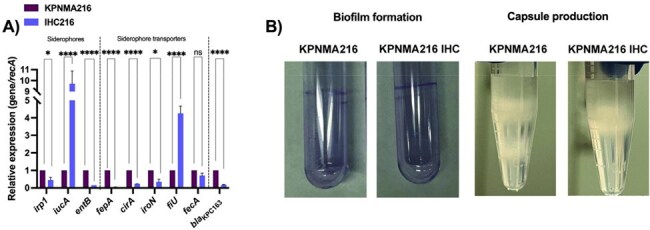 Figure 1
Peer Reviews
No public reviews on file for this paper yet. If you reviewed it on a platform where reviews are public (OpenReview, ICLR, NeurIPS, ICML), you can paste yours below so the community can read it here.
Videos
No videos yet. Explain this paper in a talk, walkthrough, or lecture? Add one.
Taxonomy
TopicsAntibiotic Resistance in Bacteria · Antibiotics Pharmacokinetics and Efficacy · Pharmaceutical and Antibiotic Environmental Impacts