P-1042. Multimodal Intervention Combining Education, Checklists, and Feedback to Sustain Low CLABSI Rates
Leena James, Jomel Raju

TL;DR
This study shows that combining education, checklists, and feedback can sustain low infection rates in a rural hospital ICU.
Contribution
A novel multimodal intervention combining education, checklists, and feedback to sustain low CLABSI rates in resource-limited settings.
Findings
CLABSI rates dropped from 2.9 to 1.2 per 1000 catheter-days over 24 months.
Bundle adherence improved from 76% to 94%, and staff knowledge scores increased from 65% to 88%.
The intervention prevented 24 infections and saved approximately USD 16,200 in healthcare costs.
Abstract
Achieving and sustaining low Central Line-Associated Bloodstream Infection (CLABSI) rates is a major challenge in resource-limited healthcare settings. This study evaluated the impact of a multimodal intervention incorporating education, standardized checklists, and structured feedback mechanisms to maintain low CLABSI rates over a 2-year period in a rural tertiary care hospital ICU in South India.Impact of Multimodal Intervention on CLABSI Rates, Bundle Adherence, and Staff Knowledge Over 24 MonthsThis graph illustrates the outcomes of implementing a multimodal strategy incorporating education, checklist audits, and structured feedback in a 12-bed adult ICU of a tertiary rural hospital in South India. Over a 24-month period (2023–2024), Central Line-Associated Bloodstream Infection (CLABSI) rates decreased from 2.9 to 1.2 per 1000 catheter-days, while bundle adherence improved from 76%…
Click any figure to enlarge with its caption.
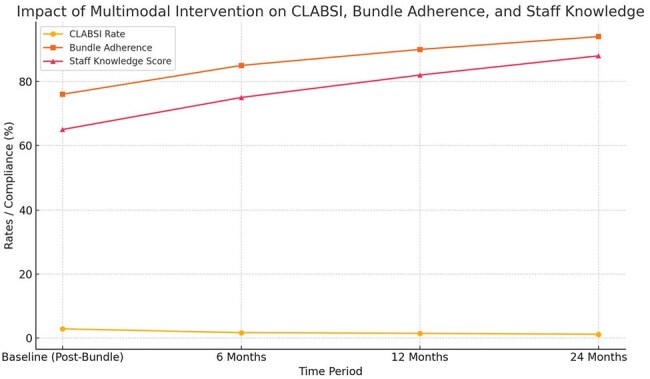 Figure 1
Peer Reviews
No public reviews on file for this paper yet. If you reviewed it on a platform where reviews are public (OpenReview, ICLR, NeurIPS, ICML), you can paste yours below so the community can read it here.
Videos
No videos yet. Explain this paper in a talk, walkthrough, or lecture? Add one.
Taxonomy
TopicsCentral Venous Catheters and Hemodialysis · Infection Control in Healthcare · Surgical site infection prevention