P-1147. Mupirocin Resistance Among Methicillin-Resistant Staphylococcus aureus Surveillance Isolates Associated with Invasive Infections, 2005-2022
Holly Biggs, Davina Campbell, Kelly A Jackson, Megan Taylor, Shirley Zhang, Joelle Nadle, Susan M Ray, Jessica Howard-Anderson, Ruth Lynfield, Carmen Bernu, Ghinwa Dumyati, Marissa Walsh, William Schaffner, Tiffanie M Markus, Keipp Talbot, Joseph D Lutgring, Amy Gargis, Isaac See

TL;DR
This study tracks mupirocin resistance in MRSA infections from 2005 to 2022 and finds no significant increase after 2014, despite its use in nasal decolonization.
Contribution
The study provides updated surveillance data on mupirocin resistance in MRSA and evaluates its association with healthcare exposures post-2014 guidelines.
Findings
High-level mupirocin resistance in MRSA isolates increased from <1% to 5.4% between 2005-2013 but stabilized afterward.
No significant association was found between mupirocin resistance and recent healthcare exposures like surgery or ICU care.
Continued monitoring is recommended to track resistance trends as decolonization practices evolve.
Abstract
Nasal decolonization with mupirocin has been noted in professional society guidance since 2014 as an optional measure to prevent methicillin-resistant Staphylococcus aureus (MRSA) infection in certain high-risk settings or patients (i.e., intensive care unit [ICU] or undergoing high-risk surgery). Because of concerns about emergence of resistance, we evaluated trends in mupirocin resistance among MRSA isolates from invasive infections and associations between healthcare exposures and resistance.Figure 1.Percentage of methicillin-resistant Staphylococcus aureus isolates from invasive infections with high-level and low-level mupirocin resistance by year, CDC Emerging Infections Program surveillance, 2005-2022 Percentage of methicillin-resistant Staphylococcus aureus isolates from invasive infections with high-level and low-level mupirocin resistance by year, CDC Emerging Infections…
Genes, proteins, chemicals, diseases, species, mutations and cell lines named across the full text — each resolved to its canonical identifier and authoritative record.
Click any figure to enlarge with its caption.
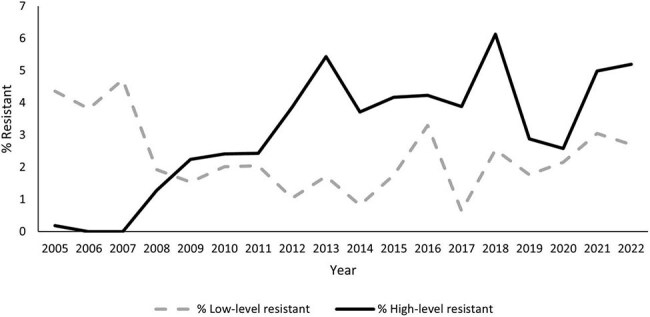 Figure 1
Peer Reviews
No public reviews on file for this paper yet. If you reviewed it on a platform where reviews are public (OpenReview, ICLR, NeurIPS, ICML), you can paste yours below so the community can read it here.
Videos
No videos yet. Explain this paper in a talk, walkthrough, or lecture? Add one.
Taxonomy
TopicsAntimicrobial Resistance in Staphylococcus · Ocular Infections and Treatments · Clostridium difficile and Clostridium perfringens research