P-422. Endotracheal Aspirate Gram Stain: Correlation with Semi-quantitative Culture Results
Talla Bitar, Kevin Lloyd, Aimee Dassner, Monika Geslak, Benjamin M Liu, Joseph M Campos, Meghan Delaney, Esther Esadah, Craig A Shapiro, Michael Evangelista, Joyce Granados, Rachel Strength, Rana F Hamdy

TL;DR
This study shows that Gram stains of endotracheal aspirates in children strongly predict culture results, especially for ruling out infections.
Contribution
The study provides evidence for the clinical utility of Gram stains in guiding the need for further culture testing in pediatric respiratory samples.
Findings
Gram stains with microorganisms had a 96.2% sensitivity for positive culture results.
98.5% of samples without microorganisms on Gram stain had no substantial bacterial growth.
Gram stain results were significantly associated with culture results (p < 0.0001).
Abstract
Endotracheal aspirate (ETA) cultures are commonly used in tracheostomy-dependent and mechanically-ventilated children with suspected lower respiratory tract infections. Gram stains of the ETA are performed before culture incubation to assess for white blood cells and microorganisms. Samples without microorganisms on Gram stain typically have low culture yield and rarely grow clinically relevant organisms. Despite this, samples with negative Gram stains are often still processed for culture. The objective is to assess the correlation between ETA Gram stain and semi-quantitative culture results at a free-standing children’s hospital.Gram Stain and Semi-quantitative Endotracheal Aspirate Culture Results Gram Stain and Semi-quantitative Endotracheal Aspirate Culture Results This is a retrospective cohort study of ETA cultures processed at the Children’s National Hospital (CNH)…
Click any figure to enlarge with its caption.
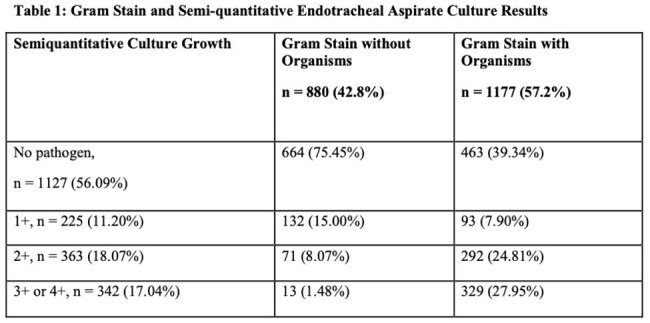 Figure 1
Peer Reviews
No public reviews on file for this paper yet. If you reviewed it on a platform where reviews are public (OpenReview, ICLR, NeurIPS, ICML), you can paste yours below so the community can read it here.
Videos
No videos yet. Explain this paper in a talk, walkthrough, or lecture? Add one.
Taxonomy
TopicsNosocomial Infections in ICU · Bacterial Identification and Susceptibility Testing · Enterobacteriaceae and Cronobacter Research