P-1726. Mucormycosis coinfection by plasma Mucorales PCR in patients with proven aspergillosis
Hyeon Mu Jang, Ji Yeon Kim, Hyeonji Seo, Sung-Han Kim

TL;DR
This study finds that about 15-20% of patients with aspergillosis may also have mucormycosis, detected using plasma PCR, highlighting the need for better diagnostic tools.
Contribution
The study introduces plasma Mucorales PCR as a method to detect mucormycosis coinfection in aspergillosis patients.
Findings
18.8% of patients with proven or probable aspergillosis showed evidence of mucormycosis coinfection via plasma PCR.
Mucormycosis coinfection did not significantly affect hospital mortality in patients treated with voriconazole.
Mucorales was not detected in fungal cultures, emphasizing the limitations of traditional diagnostic methods.
Abstract
Diagnosis of mucormycosis is challenging due to lack of antigen testing and low sensitivity of fungal culture, especially when biopsy is not feasible. There are limited data on coinfection of Aspergillus and Mucorales, although identifying coinfection is important for management. Thus, we systematically investigated mucormycosis coinfection in proven or probable aspergillosis, using plasma Mucorales PCR.Table.Diagnostic characteristics of the study participants Diagnostic characteristics of the study participants The medical records of adult patients with proven and probable aspergillosis were retrospectively reviewed at a tertiary hospital during Jan 2017 to Apr l 2020 and Jun 2023- Feb 2025. The fungal culture results were reviewed. The plasma 18S PCR was performed to detect Aspergillus- and Mucorales-specific DNA. A total of 85 patients with proven 29 and probable 56 aspergillosis…
Genes, proteins, chemicals, diseases, species, mutations and cell lines named across the full text — each resolved to its canonical identifier and authoritative record.
Click any figure to enlarge with its caption.
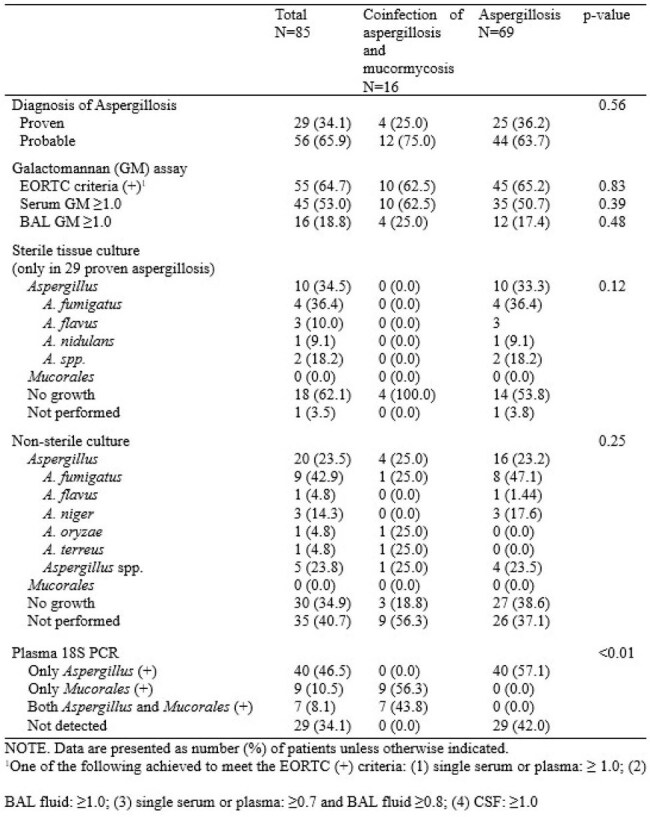 Figure 1
Peer Reviews
No public reviews on file for this paper yet. If you reviewed it on a platform where reviews are public (OpenReview, ICLR, NeurIPS, ICML), you can paste yours below so the community can read it here.
Videos
No videos yet. Explain this paper in a talk, walkthrough, or lecture? Add one.
Taxonomy
TopicsAntifungal resistance and susceptibility · Fungal Infections and Studies · Parasitic Diseases Research and Treatment