P-353. Ten Years Results on the Effectiveness and Safety of DTG+3TC as a Switch Regimen in a Multicenter Cohort
Gianmaria Baldin, Arturo Ciccullo, Adriana Cervo, Letizia Oreni, Maria Mazzitelli, Filippo Lagi, Marianna Menozzi, Alberto Borghetti, Francesca Lombardi, Andrea Giacomelli, Massimiliano Fabbiani, Stefano Rusconi, Annamaria Cattelan, Spinello Antinori, Cristina Mussini

TL;DR
This study shows that switching to DTG+3TC is effective and safe for up to 10 years in people with HIV, with minimal side effects and improved immune markers.
Contribution
Long-term (10-year) real-world evidence on the effectiveness and safety of DTG+3TC as a switch regimen in HIV treatment.
Findings
Estimated probabilities of maintaining virological suppression at 240 and 480 weeks were 96.2% and 92.8%, respectively.
Significant improvements in CD4+ count and CD4/CD8 ratio were observed after 240 weeks.
Metabolic parameters like cholesterol and triglycerides showed significant improvement at both 240 and 480 weeks.
Abstract
We aim to assess the efficacy, safety and tolerability of DTG+3TC as a switch regimen after 10 years of its introduction in clinical practice. An observational study was conducted with virologically suppressed PLWH switching to DTG+3TC in a multicenter cohort. Exclusion criteria included HBsAg+ status and M184V resistance mutation. We employed Kaplan-Meyer survival analysis for virological failure (VF) and treatment discontinuation (TD), Cox-regression for VF or TD predictors, and linear mixed models for immunological and metabolic parameter changes. We enrolled 2430 PLWH: 1587 (65.3%) were males, with a median age of 54.5 yrs. Full population characteristics are shown in Table1. During 9199 PYFU, we observed 82 VF (0.9 per 100 PYFU); no emergent resistance mutations were registered among VF. Estimated probabilities of maintaining virological suppression (VS) at 240 and 480 wks were…
Genes, proteins, chemicals, diseases, species, mutations and cell lines named across the full text — each resolved to its canonical identifier and authoritative record.
Click any figure to enlarge with its caption.
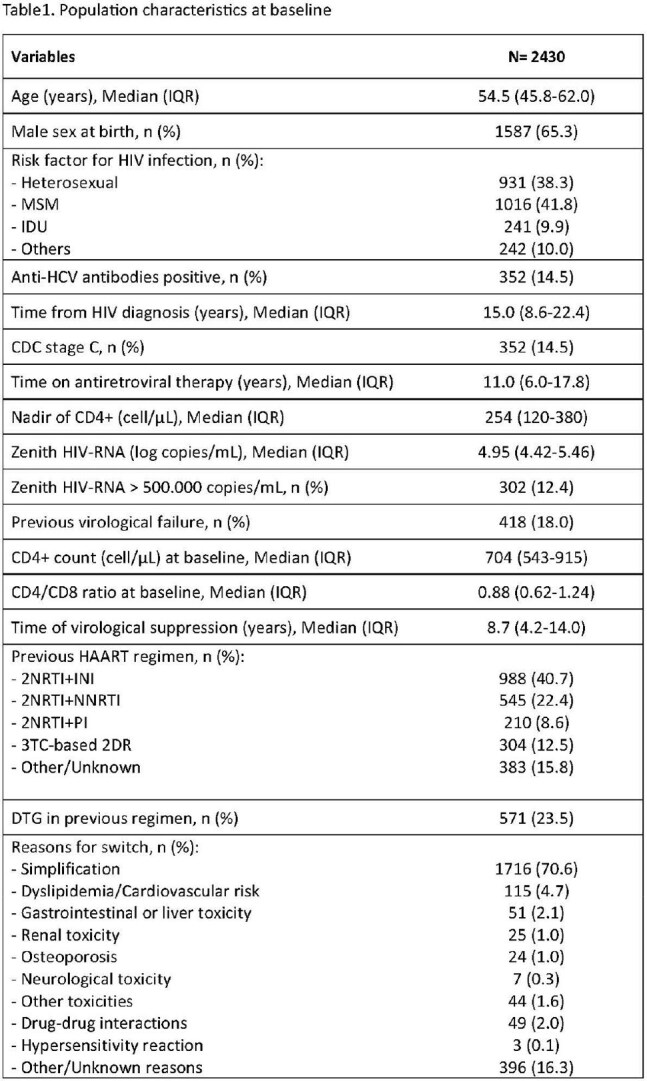 Figure 1
Peer Reviews
No public reviews on file for this paper yet. If you reviewed it on a platform where reviews are public (OpenReview, ICLR, NeurIPS, ICML), you can paste yours below so the community can read it here.
Videos
No videos yet. Explain this paper in a talk, walkthrough, or lecture? Add one.
Taxonomy
TopicsCRISPR and Genetic Engineering · Immunodeficiency and Autoimmune Disorders · Genomics and Rare Diseases