P-467. Prevalence of Meningococcal Carriage by Serogroup in Adolescents: a Global Systematic Literature Review
Zeki Kocaata, Lucian Gaianu, Ifeanyi Ubamadu, Laura Taddei, Thatiana Pinto, Hiral Shah, Pavo Marijic, Patrice Carter, Matthew Turner, Andrew Easton

TL;DR
This study reviews global data to determine which meningococcal serogroups are most commonly carried by adolescents and identifies risk factors for carriage.
Contribution
The study provides a global systematic review of meningococcal carriage in adolescents, highlighting serogroup B as the most prevalent and identifying associated risk factors.
Findings
Serogroup B was the most commonly reported meningococcal carriage in adolescents across 35 out of 37 serogroup-specific studies.
Adolescent carriage prevalence varied widely by country, ranging from 0.0% in Japan to 48.9% in Hungary.
Key risk factors for carriage included smoking, attending social gatherings, and male gender.
Abstract
Adolescents and young adults are the primary reservoir for Neisseria meningitidis, with high carriage rates and social behaviours that aid transmission. This age group represents an important proportion of outbreak cases, and plays a prominent role in transmission in the community. However, evidence is lacking on which meningococcal serogroups are carried, and risk factors for carriage. The aim of this global systematic literature review (SLR) was to assess meningococcal carriage prevalence by serogroup, age, and region, and key factors associated with carriage.Summary of ResultsYOA : Years of age Summary of Results YOA : Years of age An SLR was conducted using Medline, Embase, and public health websites to identify studies on age- and serogroup-specific meningococcal carriage prevalence (January 2000 to April 2024, no language restrictions) following PRISMA and Cochrane guidelines.…
Click any figure to enlarge with its caption.
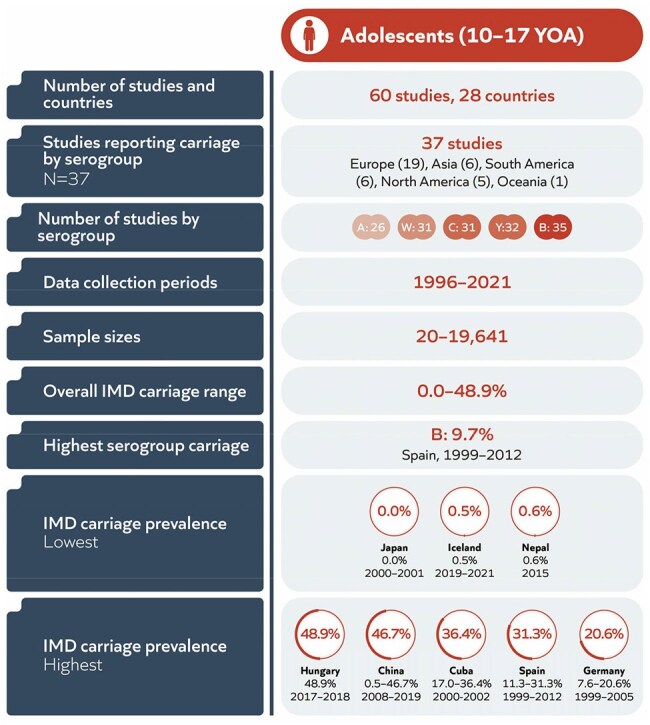 Figure 1
Peer Reviews
No public reviews on file for this paper yet. If you reviewed it on a platform where reviews are public (OpenReview, ICLR, NeurIPS, ICML), you can paste yours below so the community can read it here.
Videos
No videos yet. Explain this paper in a talk, walkthrough, or lecture? Add one.
Taxonomy
TopicsBacterial Infections and Vaccines · Reproductive tract infections research · Virology and Viral Diseases