P-1272. Assessing the Impact of Penicillin Susceptibility on Biofilm Production and Identifying asa1 Expression in Clinical Enterococcus faecalis Blood Isolates
Julian Azzouzi, Lora Todorova, Olivia Funk, Thomas Inzana, Alexey Kozlenkov, Carlos Chacon, Dianjun Cao, Jaclyn A Cusumano

TL;DR
This study examines how penicillin susceptibility and asa1 gene expression affect biofilm formation in Enterococcus faecalis blood isolates, particularly in infective endocarditis.
Contribution
The study identifies a potential inverse relationship between borderline-penicillin resistance and biofilm formation in E. faecalis isolates from infective endocarditis patients.
Findings
Penicillin susceptibility and IE presence appear to be independent factors of biofilm formation in E. faecalis.
asa1 expression levels were higher in high biofilm producers compared to low producers.
Borderline-penicillin resistance showed a trend towards reduced biofilm formation and lower IE presence.
Abstract
Enterococcus faecalis infective endocarditis (IE) mortality without surgical biofilm removal is up to 75%. Further complicating treatment, borderline-penicillin (PCN)-resistant, ampicillin-susceptible E. faecalis (borderline-PRASEF; PCN MIC 4-8 µg/mL) reduces standard-of-care ampicillin-ceftriaxone activity in vitro. Bacterial adhesion is the first stage of biofilm formation and is mediated by asa1 in E. faecalis, but the exact relationship to biofilm formation is unknown. Biofilm mass was quantified in 138 clinical E. faecalis blood isolates from New York, NY; Albany, NY; and Barcelona, Spain, including 97 from patients with IE. PCN susceptibility was assessed by broth microdilution, identifying 64 borderline-PRASEF and 74 PCN-susceptible (PCN-S, MIC ≤ 2 µg/mL) isolates. ATCC 29212 and JH2-2 served as high and low biofilm controls, respectively. Biofilms were grown for 72 hours at…
Genes, proteins, chemicals, diseases, species, mutations and cell lines named across the full text — each resolved to its canonical identifier and authoritative record.
Click any figure to enlarge with its caption.
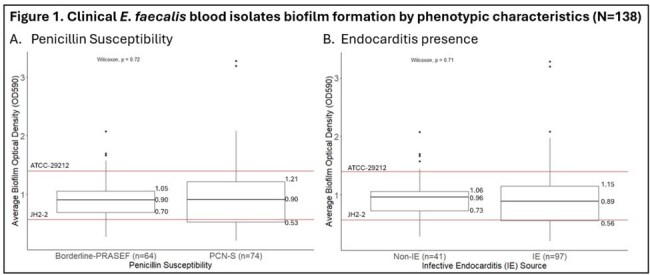 Figure 1
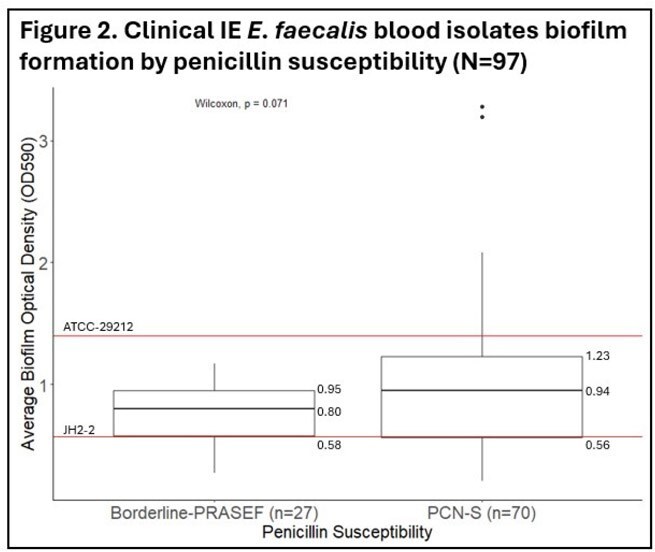 Figure 2
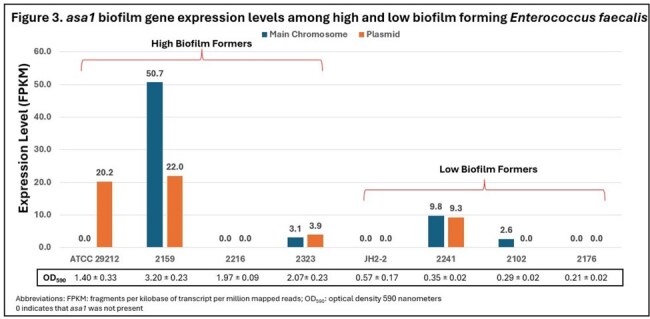 Figure 3
Peer Reviews
No public reviews on file for this paper yet. If you reviewed it on a platform where reviews are public (OpenReview, ICLR, NeurIPS, ICML), you can paste yours below so the community can read it here.
Videos
No videos yet. Explain this paper in a talk, walkthrough, or lecture? Add one.
Taxonomy
TopicsInfective Endocarditis Diagnosis and Management · Antimicrobial Resistance in Staphylococcus · Clostridium difficile and Clostridium perfringens research