P-1530. Microbiome factors associated with fluoroquinolone-resistant Enterobacterales bloodstream infection in hematopoietic cell transplant recipients receiving fluoroquinolone prophylaxis
Grace A Maldarelli, Jamie Marino, John Lee, Lars Westblade, Michael Hovan, Claire Douglass, Emily Davidson, Randy S Longman, Michael J Satlin

TL;DR
This study explores how gut bacteria might influence bloodstream infections caused by antibiotic-resistant bacteria in patients undergoing a specific type of cell transplant.
Contribution
The study identifies microbiome factors associated with fluoroquinolone-resistant Enterobacterales bloodstream infections in patients receiving fluoroquinolone prophylaxis.
Findings
FQRE-colonized patients had higher Bacteroidales abundance pre-HCT compared to non-colonized patients.
Bacteroidales abundance was lower in FQRE-colonized patients who developed FQRE BSI.
Post-HCT, higher Enterobacterales abundance was observed in patients who developed FQRE BSI.
Abstract
Hematopoietic cell transplantation (HCT) is potentially curative for hematologic malignancies, but leads to a profound neutropenia that predisposes to bloodstream infections (BSIs) due to Enterobacterales. While fluoroquinolone (FQ) prophylaxis decreases risk of Enterobacterales BSI, HCT recipients colonized with fluoroquinolone-resistant Enterobacterales (FQRE) prior to HCT frequently develop Enterobacterales BSI despite FQ prophylaxis. We hypothesized that there are differences in microbiome composition between FQRE-colonized and non-colonized patients, and between colonized patients who develop FQRE BSI and those who do not. We collected stool specimens during pre- and post-HCT weeks from patients undergoing HCT from 2016-2019 at a single center. Specimens underwent quantitative culturing for FQRE. DNA was isolated for 16S rRNA sequencing. We evaluated microbiome diversity and…
Genes, proteins, chemicals, diseases, species, mutations and cell lines named across the full text — each resolved to its canonical identifier and authoritative record.
Click any figure to enlarge with its caption.
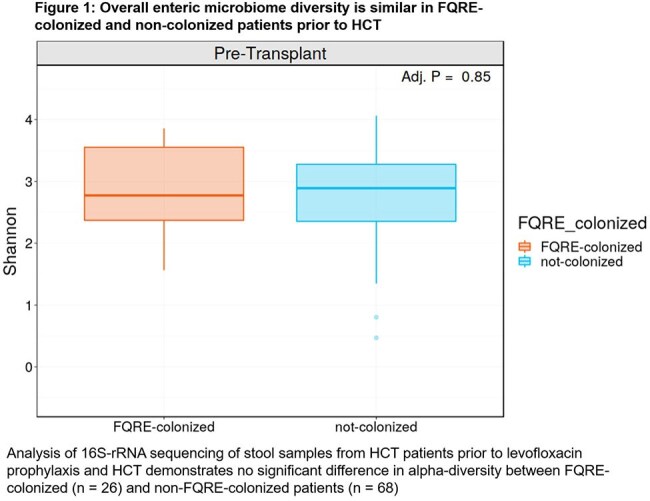 Figure 1
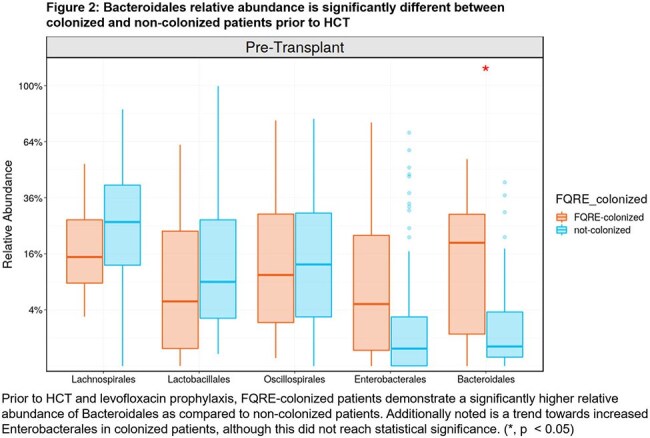 Figure 2
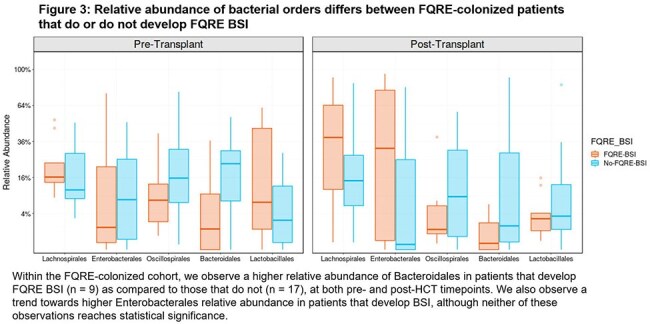 Figure 3
Peer Reviews
No public reviews on file for this paper yet. If you reviewed it on a platform where reviews are public (OpenReview, ICLR, NeurIPS, ICML), you can paste yours below so the community can read it here.
Videos
No videos yet. Explain this paper in a talk, walkthrough, or lecture? Add one.
Taxonomy
TopicsNeutropenia and Cancer Infections · Gut microbiota and health · Clostridium difficile and Clostridium perfringens research