P-1540. Virulence Analysis of Type VI Secretion System in Neonatal Meningitis E. coli using Galleria mellonella as an Infection Model
Julia Ienes-Lima, Ariana Martinez, Aline de Oliveira, Lisa Nolan, Catherine Logue

TL;DR
This study investigates how the Type VI Secretion System (T6SS) affects the virulence of E. coli causing neonatal meningitis using a waxworm infection model.
Contribution
The study identifies specific T6SS genes that reduce E. coli virulence in a Galleria mellonella model and compares virulence across different serogroups.
Findings
Deletion of hcp and icmF genes in O18 E. coli reduced virulence, increasing larval survival to 85% and 65%.
O7 and O45 serogroup strains caused 100% mortality in larvae within 24 hours, suggesting additional virulence factors.
T6SS+ strains O18, O12, and O78 showed low survival and high disease scores, while O16 and O83 had higher survival and lower scores.
Abstract
Neonatal meningitis E. coli (NMEC) is a common cause of bacterial meningitis in newborns worldwide. NMEC replicates within macrophages, survives in the bloodstream, and traverses the blood-brain barrier, resulting in meningitis. Most NMEC cases are associated with serogroups O18, O83, O7, O12, O1, and O45. Two clusters of the Type 6 secretion system (T6SS) (T6SS-1 and T6SS-2) were identified in NMEC O18:K1. Studies demonstrated that the T6SS plays a key role in pathogenesis and biofilm formation of NMEC, though the function of specific T6SS genes remains unclear. This study aimed to investigate the T6SS role in NMEC virulence through in vivo infection of Galleria mellonella larvae, hypothesizing that deletion of T6SS genes would reduce strain virulence.Figure 1.Kaplan-Meier survival curve of G. mellonella larvae infected with T6SS mutant strains.Figure 2.Larval Disease Score (LDS) of…
Genes, proteins, chemicals, diseases, species, mutations and cell lines named across the full text — each resolved to its canonical identifier and authoritative record.
Click any figure to enlarge with its caption.
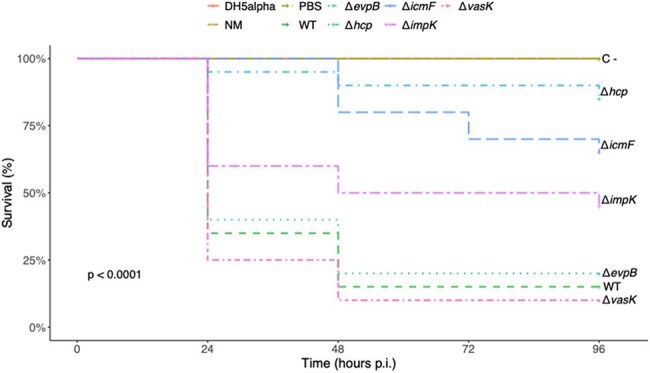 Figure 1
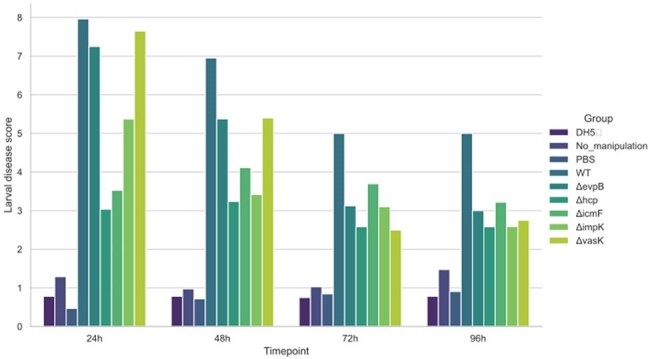 Figure 2
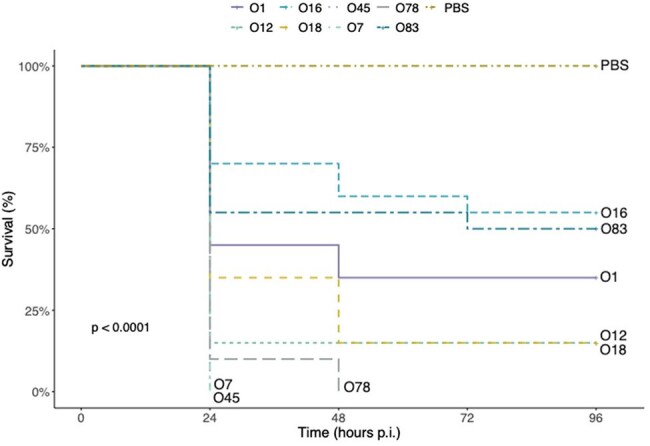 Figure 3
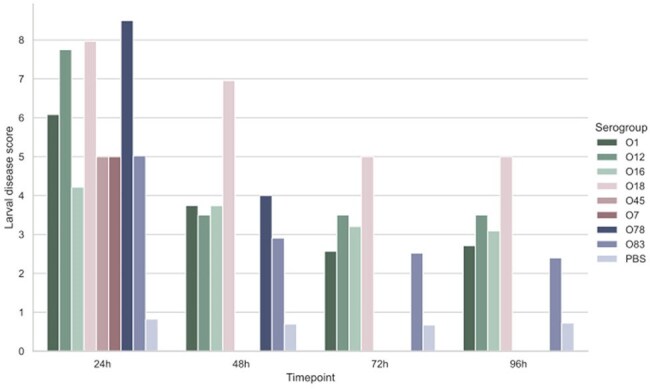 Figure 4
Peer Reviews
No public reviews on file for this paper yet. If you reviewed it on a platform where reviews are public (OpenReview, ICLR, NeurIPS, ICML), you can paste yours below so the community can read it here.
Videos
No videos yet. Explain this paper in a talk, walkthrough, or lecture? Add one.
Taxonomy
TopicsInvertebrate Immune Response Mechanisms · Viral Infectious Diseases and Gene Expression in Insects · Escherichia coli research studies