P-726. Rates of Follow-up Testing for Active-Duty Service Members with Syphilis at Joint Base San Antonio
James J Marsh, Joseph Marcus

TL;DR
This study found that most active-duty service members with syphilis at Joint Base San Antonio received follow-up testing, though late-stage cases had lower follow-up rates.
Contribution
The study provides new data on syphilis follow-up testing rates among active-duty military members at a specific base.
Findings
74% of syphilis patients had a follow-up RPR test within one year of diagnosis.
Late latent syphilis cases had the lowest follow-up testing rates.
Older age and HIV status were associated with higher follow-up testing rates.
Abstract
Current guidelines recommend follow-up testing for syphilis to confirm treatment efficacy. Syphilis rates are higher in the United States military compared to the general population. Despite these higher rates of infection, previous data on military blood donors demonstrated less than one-third received a follow-up rapid plasma reagin (RPR) test within one year after diagnosis. It is unknown if this low follow-up rate exists across different military cohorts.Table 1.Demographic Information of 41 Individuals Diagnosed with Syphilis at Joint Base San Antonio January 2022-August 2024Table 2.Factors Associated with Follow-up Rapid Plasma Reagin Test After Syphilis Diagnosis Demographic Information of 41 Individuals Diagnosed with Syphilis at Joint Base San Antonio January 2022-August 2024 Factors Associated with Follow-up Rapid Plasma Reagin Test After Syphilis Diagnosis A retrospective…
Genes, proteins, chemicals, diseases, species, mutations and cell lines named across the full text — each resolved to its canonical identifier and authoritative record.
Click any figure to enlarge with its caption.
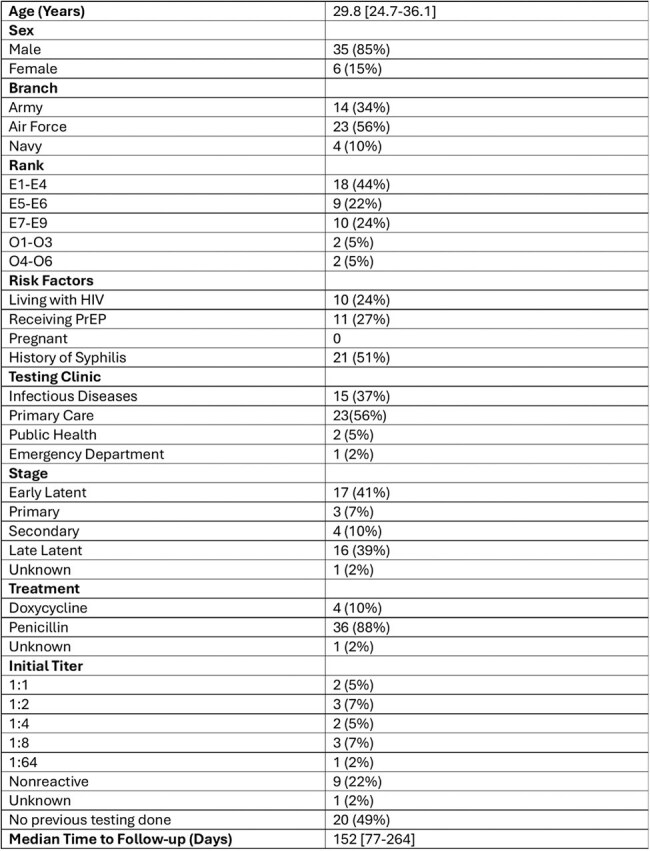 Figure 1
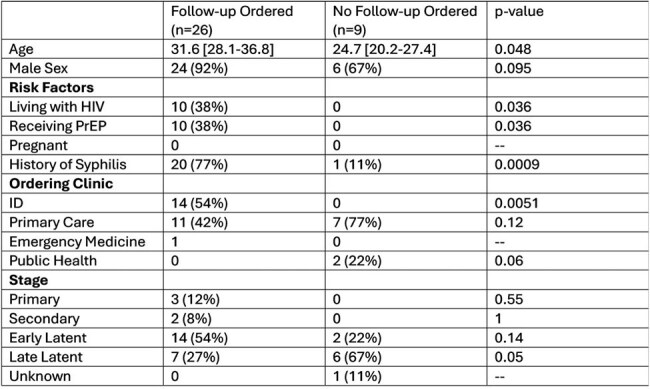 Figure 2
Peer Reviews
No public reviews on file for this paper yet. If you reviewed it on a platform where reviews are public (OpenReview, ICLR, NeurIPS, ICML), you can paste yours below so the community can read it here.
Videos
No videos yet. Explain this paper in a talk, walkthrough, or lecture? Add one.
Taxonomy
TopicsSyphilis Diagnosis and Treatment · Reproductive tract infections research · HIV, Drug Use, Sexual Risk