171. Efficacy and Immunogenicity of WRSs2, a Live Attenuated Shigella sonnei Vaccine Candidate, to Protect Against Shigellosis After Challenge with a Wild-type S. sonnei strain 53G
Robert W Frenck, Nadine Rouphael, Shahida Baqar, Michelle Dickey, Veronica Smith, Jill El-Khorazaty, Monica McNeil, Christina M Quigley, Erin Scherer, Jamie Fraser, Tena Pham, Carson Caldwell, Lori Newman, Sarah Bechnak, Shoshana Barnoy, Lakshmi Chandrasekaran, Chad Porter

TL;DR
A new live attenuated Shigella vaccine, WRSs2, showed high efficacy in preventing shigellosis in a clinical trial, with promising immune responses observed.
Contribution
Demonstrates high efficacy of WRSs2 vaccine against Shigella sonnei in a controlled human infection model.
Findings
Two doses of WRSs2 provided 89% efficacy against shigellosis.
One dose of WRSs2 showed 100% efficacy in preventing disease.
Vaccine recipients developed strong IgA and IgG immune responses.
Abstract
Shigella is a leading cause of bacterial diarrhea. The live attenuated S. sonnei vaccine candidate WRSs2, lacking virG (icsA), senA, and senB, was evaluated for its efficacy in preventing shigellosis.Serum LPS IgG GMT, By Group Over TimeStool Shedding, WRSs2 Serum LPS IgG GMT, By Group Over Time Stool Shedding, WRSs2 Adults aged 18-49 years received 2 doses of study product 28 days apart (1 or 2 doses of 106 colony forming units (cfu) of WRSs2 or placebo). 4 weeks after vaccination, using a controlled human infection model (CHIM), participants were administered 1500 cfu of virulent S. sonnei (53G) in an inpatient unit. After challenge, participants were evaluated daily and stools were graded and cultured for Shigella. 5 days post-challenge, ciprofloxacin (500 mg BID x 3 days) was administered. Discharge home was based on antibiotic completion and 2 stool cultures negative for S.…
Genes, proteins, chemicals, diseases, species, mutations and cell lines named across the full text — each resolved to its canonical identifier and authoritative record.
Click any figure to enlarge with its caption.
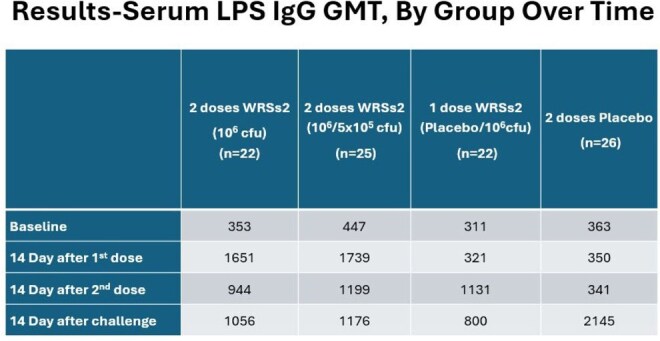 Figure 1
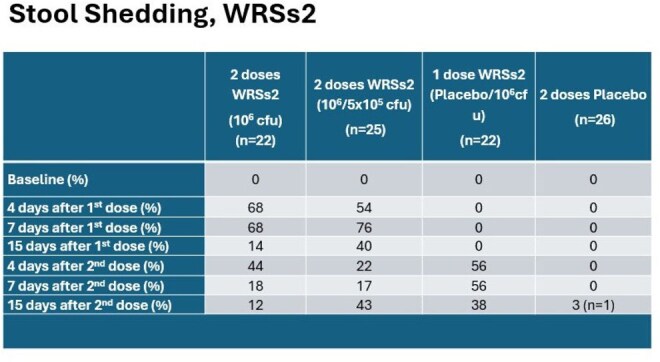 Figure 2
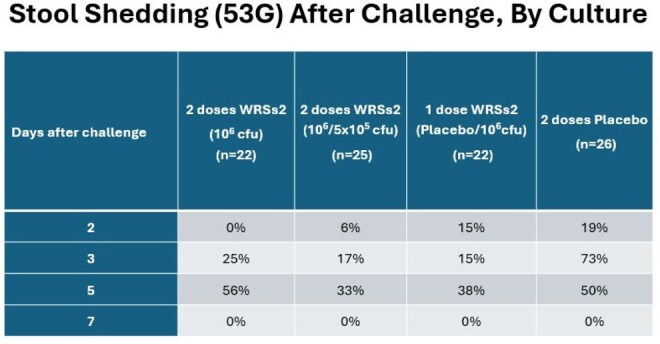 Figure 3
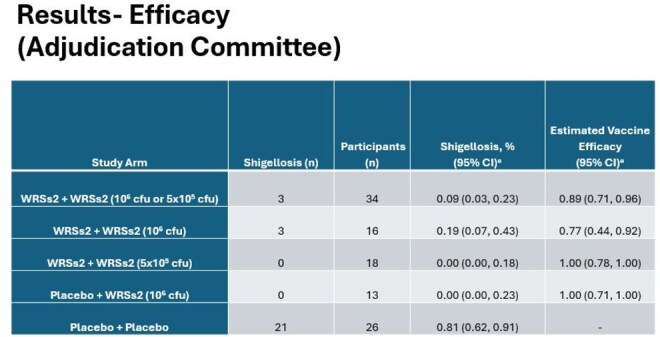 Figure 4
Peer Reviews
No public reviews on file for this paper yet. If you reviewed it on a platform where reviews are public (OpenReview, ICLR, NeurIPS, ICML), you can paste yours below so the community can read it here.
Videos
No videos yet. Explain this paper in a talk, walkthrough, or lecture? Add one.
Taxonomy
TopicsEscherichia coli research studies · Viral gastroenteritis research and epidemiology · Clostridium difficile and Clostridium perfringens research