434. Impact of a Blood Culture Stewardship Initiative Among Pediatric Febrile Neutropenia Patients on Reducing Carbon Emissions
Adriana Gardner, Michelle L Kussin, Carmen Dunn Smith, Muayad Allali

TL;DR
A hospital initiative reduced blood cultures for sick children, cutting carbon emissions by the equivalent of driving 87 miles.
Contribution
A pediatric blood culture stewardship program reduced carbon emissions through fewer microbiology tests.
Findings
Annual blood culture bottles decreased by 31% after the stewardship initiative.
The program reduced carbon emissions by 34.9 kg CO2e annually.
Emissions savings equate to driving 87 miles in a passenger vehicle.
Abstract
In the United States, the healthcare sector is responsible for about 8.5% of national greenhouse gas emissions. Diagnostic stewardship initiatives can help mitigate these emissions. At Riley Children’s Hospital, a blood culture stewardship initiative was implemented to reduce the number of repeat blood cultures ordered for pediatric febrile neutropenia patients. The purpose of this study was to calculate the reduction in carbon emissions from the blood culture microbiology waste associated with the blood culture stewardship initiative. Starting January 1, 2023, a new febrile neutropenia blood culture protocol was implemented, limiting repeat blood cultures after 48 hours to patients with hemodynamic instability or recurrent fever (defined as a new fever occurring ≥72 hours after being afebrile). The number of blood culture bottles use before (January 2017 to December 2022) and after…
Click any figure to enlarge with its caption.
 Figure 1
 Figure 2
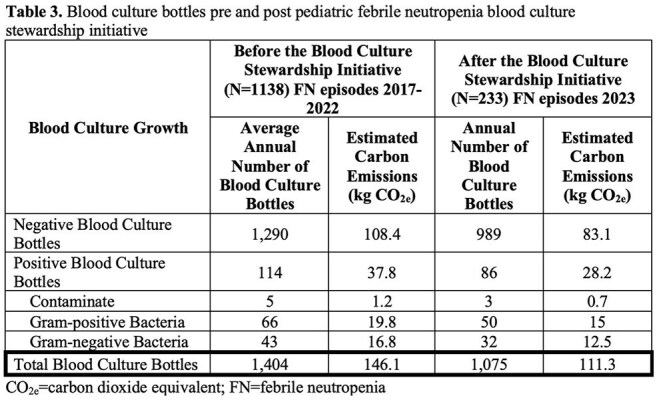 Figure 3
Peer Reviews
No public reviews on file for this paper yet. If you reviewed it on a platform where reviews are public (OpenReview, ICLR, NeurIPS, ICML), you can paste yours below so the community can read it here.
Videos
No videos yet. Explain this paper in a talk, walkthrough, or lecture? Add one.
Taxonomy
TopicsNeutropenia and Cancer Infections · Bacterial Identification and Susceptibility Testing · Neonatal and Maternal Infections