P-655. The Relative Risk of Acute Cardiopulmonary Events Following Hospitalization with Respiratory Syncytial Virus or Human Metapneumovirus Infection: A Modified Self-Controlled Case Series Analysis
Lisa Glasser, Corey Fang, Chengbin Wang, Renee Gennarelli, Kainan Sun, Casey A Dobie, Xiaohui Zhao, Aimee Near

TL;DR
This study examines how hospitalization with RSV or hMPV increases the risk of acute cardiopulmonary events in older adults using a modified self-controlled case series design.
Contribution
The study introduces a modified self-controlled case series design to reduce selection bias and improve generalizability in assessing post-viral cardiopulmonary risks.
Findings
RSV hospitalization is associated with increased risk of acute cardiopulmonary events in older adults.
The modified self-controlled case series design improves accuracy in risk estimation by including all patients with the exposure.
Findings highlight the importance of monitoring cardiopulmonary health post-RSV/hMPV hospitalization.
Abstract
Respiratory syncytial virus (RSV) and human metapneumovirus (hMPV) are common causes of respiratory infections. Sharing similar pathogenesis, both viruses cause significant morbidity and mortality in older adults. While RSV infection has been documented to increase the risk of acute cardiopulmonary events in adults, contemporary real-world data post-COVID-19 pandemic on RSV and similar data on hMPV are limited.Figure 1.Study designaThe study employed a modified self-control case series design, in which all patients who had the exposure (i.e., hospitalization with ICD-10-CM-coded RSV or hMPV) were analyzed, and the time periods of interest (control, buffer, risk) were anchored on the exposure. This modified approach minimizes selection bias and more accurately reflects the true underlying risk in the exposed population. It also enhances the generalizability to the exposed population by…
Genes, proteins, chemicals, diseases, species, mutations and cell lines named across the full text — each resolved to its canonical identifier and authoritative record.
Click any figure to enlarge with its caption.
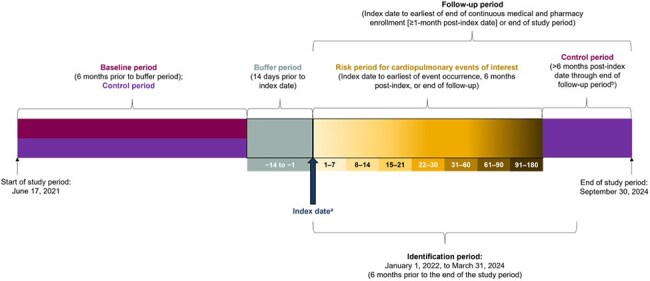 Figure 1
 Figure 2
 Figure 3
 Figure 4
Peer Reviews
No public reviews on file for this paper yet. If you reviewed it on a platform where reviews are public (OpenReview, ICLR, NeurIPS, ICML), you can paste yours below so the community can read it here.
Videos
No videos yet. Explain this paper in a talk, walkthrough, or lecture? Add one.
Taxonomy
TopicsRespiratory viral infections research · COVID-19 Clinical Research Studies · SARS-CoV-2 detection and testing