P-637. Underlying Medical Conditions in Children 8 to <20 Months of Age Hospitalized with Respiratory Syncytial Virus
Julia Bratic, Tess Stopczynski, Leila C Sahni, Pedro A Piedra, Laura S Stewart, Marian G Michaels, John Williams, Rangaraj Selvarangan, Jennifer E Schuster, Daniel C Payne, Mary A Staat, Eileen J Klein, Janet A Englund, Geoffrey A Weinberg, Peter G Szilagyi, Ariana Toepfer

TL;DR
This study examines hospitalizations of children aged 8 to 20 months with underlying medical conditions due to RSV, finding that most were not eligible for nirsevimab and were often premature.
Contribution
The study identifies that most hospitalized RSV-positive children with UMCs are not nirsevimab-eligible and highlights the prevalence of prematurity in this group.
Findings
80% of ICU admissions were nirsevimab-ineligible children.
51.6% of nirsevimab-ineligible children were premature with a median gestational age of 34 weeks.
Only 10% of hospitalized children with UMCs were nirsevimab-eligible.
Abstract
Nirsevimab, a highly effective monoclonal antibody, is recommended for all infants < 8 months of age and high-risk patients 8 to < 20 months of age with chronic lung disease (CLD) of prematurity, cystic fibrosis (CF), severe immunocompromise or who are American Indian/Alaska Native (AI/AN) to prevent RSV.1,2 Other children with underlying medical conditions (UMCs) may also benefit from nirsevimab. We characterized the clinical course of RSV-associated hospitalization in children with UMCs by nirsevimab eligibility.Figure 1.Underlying medical conditions1 for hospitalized children with at least one underlying medical condition aged 8 to <20 months ineligible for nirsevimab (n=523, 12/01/2016 to 07/16/2023).1Prematurity defined as <37 weeks gestation. Atopic conditions include atopic/allergic conditions not including asthma/RAD. Genetic/metabolic conditions include development disorders…
Genes, proteins, chemicals, diseases, species, mutations and cell lines named across the full text — each resolved to its canonical identifier and authoritative record.
Click any figure to enlarge with its caption.
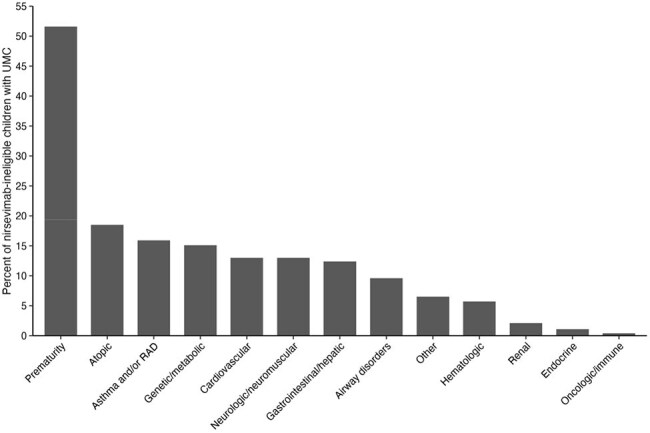 Figure 1
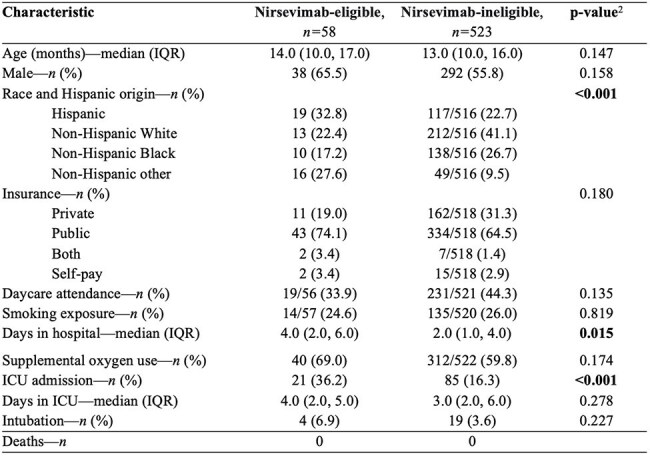 Figure 2
Peer Reviews
No public reviews on file for this paper yet. If you reviewed it on a platform where reviews are public (OpenReview, ICLR, NeurIPS, ICML), you can paste yours below so the community can read it here.
Videos
No videos yet. Explain this paper in a talk, walkthrough, or lecture? Add one.
Taxonomy
TopicsRespiratory viral infections research · Immunodeficiency and Autoimmune Disorders · Neonatal Respiratory Health Research