P-313. Black Women’s Experiences on Long-Acting Cabotegravir for PrEP: Interim Patient Findings from the EBONI Study
Katherine L Nelson, Zandraetta Tims-Cook, Helena Kwakwa, Megan Dieterich, Tammeka Evans, Alftan Dyson, Neetu Badhoniya, Heidi Swygard, Michael Aboud, Kenneth Sutton, Denise Sutherland-Phillips, Dhuly Chowdhury, Nicole Mack, Piotr Budnik, Kimberley Brown, Maggie Czarnogorski

TL;DR
Black women in the US found long-acting HIV prevention injections (CAB LA) to be accessible, acceptable, and satisfying after four months of use.
Contribution
This study provides interim insights into the real-world experiences of Black women using CAB LA for HIV prevention in the US.
Findings
Most Black women found CAB LA accessible, with convenient clinic hours and ease of travel for injections.
Participants reported high satisfaction with CAB LA, including low injection pain and positive feelings about the treatment.
Shared decision-making with providers and appointment reminders were key factors in successful CAB LA use.
Abstract
Black women represent ∼50% of new HIV diagnoses among transgender and cisgender US women, yet HIV PrEP uptake remains low. EBONI, a Phase IV study, evaluates long-acting cabotegravir (CAB LA) for PrEP delivery to Black women in US EHE areas. We present interim (4-month) experiences of access, delivery, and satisfaction with CAB LA among Black cis- and transgender women receiving CAB LA. From April 2023–February 2025, 130 Black women from 19 clinics completed interim surveys. Descriptive statistics were generated. Black women were mostly cisgender (78%) and non-Hispanic (94%); mean age was 37.8 years (SD=10.5). Most women who had sex in the last 6 months (88%) had no sexual partners with HIV (62%) and did not have sexual partners taking PrEP (63%). CAB LA was accessible to Black women, with 84% reporting convenient clinic hours, 85% reporting no difficulty getting to the clinic every…
Genes, proteins, chemicals, diseases, species, mutations and cell lines named across the full text — each resolved to its canonical identifier and authoritative record.
Click any figure to enlarge with its caption.
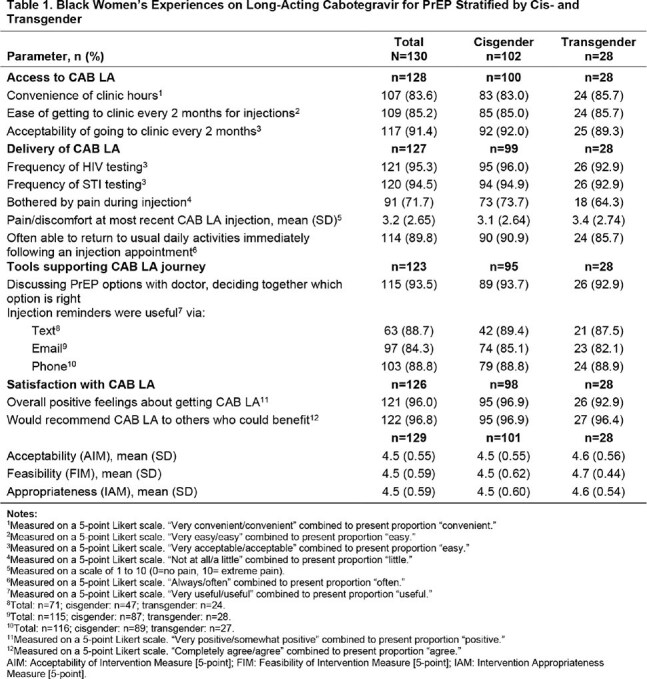 Figure 1
Peer Reviews
No public reviews on file for this paper yet. If you reviewed it on a platform where reviews are public (OpenReview, ICLR, NeurIPS, ICML), you can paste yours below so the community can read it here.
Videos
No videos yet. Explain this paper in a talk, walkthrough, or lecture? Add one.
Taxonomy
TopicsHIV/AIDS Research and Interventions · HIV, Drug Use, Sexual Risk · HIV/AIDS drug development and treatment