P-485. Healthcare-associated Respiratory Syncytial Virus (RSV) Infection During Prolonged Birth Hospitalization: Is There a Role for Nirsevimab?
Pablo J Sanchez, Sarah King, Helena Brenes-Chacon, Matthew Washam, Samiksha Tarun, Stacie Rhoades, Cristina Tomatis Souverbielle, Asuncion Mejias

TL;DR
The study examines healthcare-associated RSV infections in infants during birth hospitalization and evaluates the potential role of nirsevimab in prevention.
Contribution
The study provides insights into the frequency of healthcare-associated RSV in infants and assesses the potential impact of nirsevimab administration timing.
Findings
From 2012 to 2024, 76 healthcare-associated RSV infections occurred in infants under 2 years, with 18 (24%) during birth hospitalization.
None of the 18 infants had received RSV immunoprophylaxis, and no deaths were reported.
Use of nirsevimab could prevent some healthcare-associated RSV cases but would require immunizing many infants.
Abstract
On 8/3/2023, the CDC/Advisory Committee on Immunization Practices recommended nirsevimab, a long-acting monoclonal antibody, for prevention of RSV-associated lower respiratory tract infection in all infants aged < 8 months and some high-risk young children aged 8-19 months. At Nationwide Children’s Hospital (NCH; 673 beds) and its 7 affiliated NICUs ( > 3,000 admissions/year) in Columbus, OH, infants with prolonged birth hospitalization related to prematurity or other causes receive nirsevimab shortly before hospital discharge. Earlier use of nirsevimab for prevention of healthcare-associated (HA) RSV disease was not recommended. However, HA-RSV disease is associated with substantial morbidity and occasional mortality, mainly in children with underlying medical conditions. Our objective was to determine the magnitude and review the cases of HA-RSV infections at NCH and its NICUs in…
Genes, proteins, chemicals, diseases, species, mutations and cell lines named across the full text — each resolved to its canonical identifier and authoritative record.
Click any figure to enlarge with its caption.
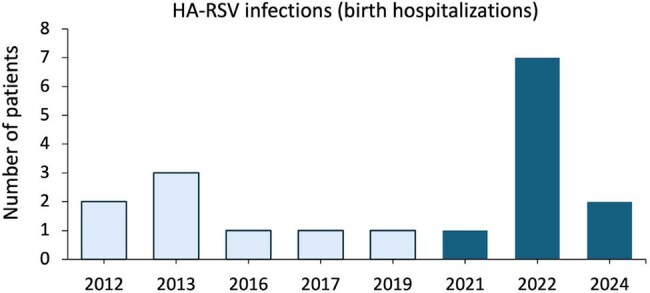 Figure 1
Peer Reviews
No public reviews on file for this paper yet. If you reviewed it on a platform where reviews are public (OpenReview, ICLR, NeurIPS, ICML), you can paste yours below so the community can read it here.
Videos
No videos yet. Explain this paper in a talk, walkthrough, or lecture? Add one.
Taxonomy
TopicsRespiratory viral infections research · COVID-19 Impact on Reproduction · Neonatal Respiratory Health Research