P-1007. Head-to-Head Comparison of “Soft Stop” and “Hard Stop” alerts for the Diagnostic Stewardship of Clostridioides difficile PCR testing
fnu sonia, Kamil Dzieniszewski, Jamie Palazzo, Vishnu Chaturvedi, Donald S Chen, Marina Keller

TL;DR
This study compares two types of alerts in electronic medical records to reduce inappropriate Cdiff testing, finding that a 'hard stop' alert is more effective than a 'soft stop' alert.
Contribution
The paper presents a head-to-head comparison of 'soft stop' and 'hard stop' alerts for Cdiff PCR diagnostic stewardship in a single institution.
Findings
The 'soft stop' alert did not significantly lower the hospital-onset Cdiff rate.
The 'hard stop' alert led to a statistically significant reduction in the standardized infection rate (SIR).
Cdiff PCR testing decreased over the study period with stable positivity rates.
Abstract
Clostridioides difficile (Cdiff)-associated diarrhea is a significant nosocomial infection. In the United States, hospitals report every new positive Cdiff test. The financial penalties for high rates of hospital onset tests (i.e. after day 3) incentivize institutions to implement rigorous diagnostic stewardship. Studies have shown that “soft stop” or “hard stop” alerts, limiting options in the order menus, and reflex testing are effective. We conducted a head-to-head comparison of both “soft stop” and “hard stop” alert in the same institution over several years.TABLE 1.Cdiff PCR testing patterns Cdiff PCR testing patterns Figure 1– Timeline of the 2 phased quality improvement project to reduce inappropriate ordering of Cdiff PCR tests while patients receive laxatives – Timeline of the 2 phased quality improvement project to reduce inappropriate ordering of Cdiff PCR tests while…
Genes, proteins, chemicals, diseases, species, mutations and cell lines named across the full text — each resolved to its canonical identifier and authoritative record.
Click any figure to enlarge with its caption.
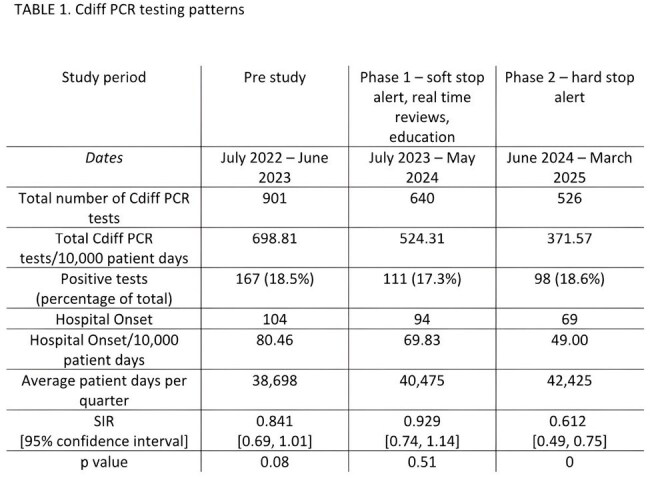 Figure 1
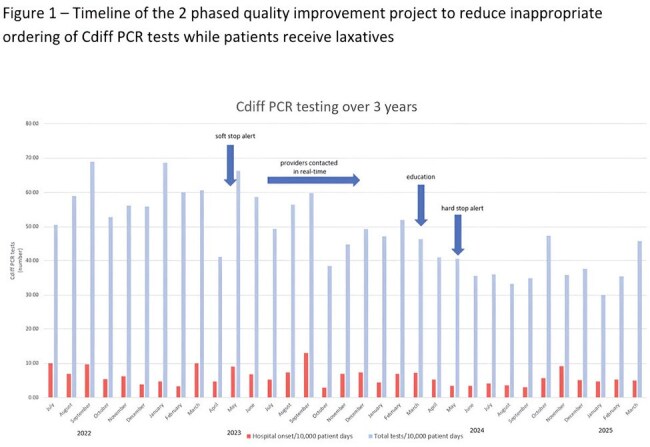 Figure 2
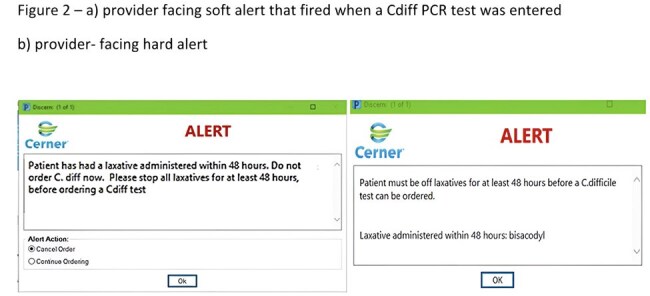 Figure 3
Peer Reviews
No public reviews on file for this paper yet. If you reviewed it on a platform where reviews are public (OpenReview, ICLR, NeurIPS, ICML), you can paste yours below so the community can read it here.
Videos
No videos yet. Explain this paper in a talk, walkthrough, or lecture? Add one.
Taxonomy
TopicsClostridium difficile and Clostridium perfringens research · Infection Control in Healthcare · Nosocomial Infections in ICU