P-1410. Exposure to Potential Environmental and Zoonotic Reservoirs of Mycobacterium leprae Among Individuals with Hansen’s disease, Central Florida
Shamika V Chavda, Charlotte Avanzi, Tolulope Ojo-Akosile, DaJhe Sullivan, Annemieke Geluk, Paul L A M Corstjens, Norman Beatty, Kartikeya Cherabuddi, Andrew Miner, Jessica K Fairley

TL;DR
This study examines environmental and zoonotic exposure factors linked to leprosy in Florida, finding that soil contact is more common among patients than their household contacts.
Contribution
The study provides new insights into environmental transmission of Mycobacterium leprae in Florida, highlighting soil contact as a potential risk factor.
Findings
Frequent soil contact was reported more often among leprosy patients than their household contacts.
Armadillo contact did not significantly differ between patients and contacts.
Travel to high-risk countries was not a common factor among study participants.
Abstract
Hansen’s disease (HD, leprosy), caused by Mycobacterium leprae and M. lepromatosis, remains endemic in parts of the southeastern United States with increasing incidence in Florida. In 2023, Florida accounted for 23 of 225 U.S. cases. The nine-banded armadillo is a known reservoir for M. leprae with mounting evidence of its role in transmission. M. leprae has also shown viability in soil, prompting examination of environmental exposures. Therefore, we aimed to explore environmental exposures in those with HD versus household contactsTable 1.Demographic Characteristics of Index Cases & ContactsTable 2.Environmental Exposures for Index Cases & Contacts Demographic Characteristics of Index Cases & Contacts Environmental Exposures for Index Cases & Contacts We recruited participants from private dermatology clinics in East/Central Florida. Eligible individuals included those diagnosed…
Genes, proteins, chemicals, diseases, species, mutations and cell lines named across the full text — each resolved to its canonical identifier and authoritative record.
Click any figure to enlarge with its caption.
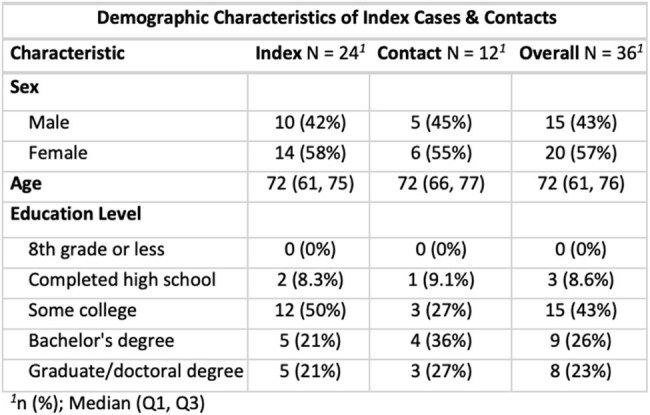 Figure 1
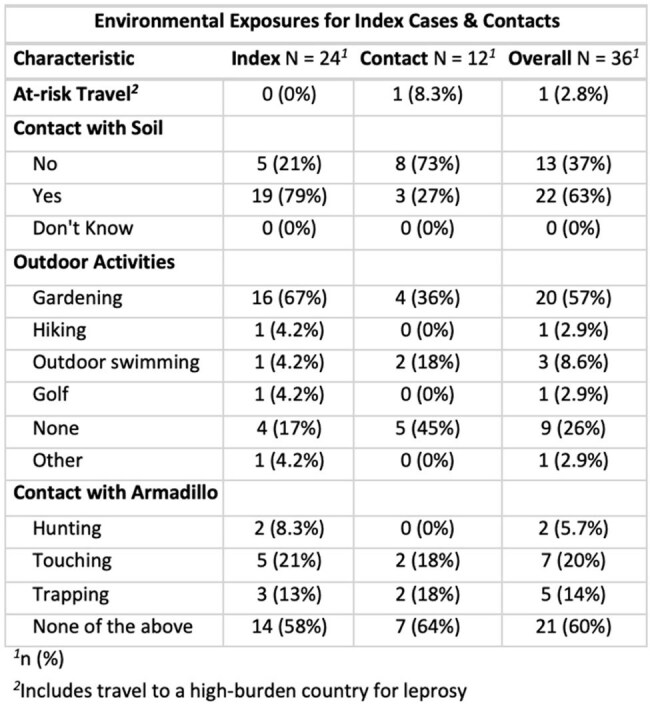 Figure 2
Peer Reviews
No public reviews on file for this paper yet. If you reviewed it on a platform where reviews are public (OpenReview, ICLR, NeurIPS, ICML), you can paste yours below so the community can read it here.
Videos
No videos yet. Explain this paper in a talk, walkthrough, or lecture? Add one.
Taxonomy
TopicsLeprosy Research and Treatment · Mycobacterium research and diagnosis · Yersinia bacterium, plague, ectoparasites research