P-1772. Diagnostic Utility of Fluorescent Antibody Microscopy (FAM) for Giardiasis and Cryptosporidiosis
Akira Kawashima, Yusuke Oshiro, Megumi Akashi, Yasuaki Yanagawa, Rieko Shimogawara, Masami Kurokawa, Naokatsu Ando, Haruka Uemura, Takahiro Aoki, Kei Yamamoto, Junichi Akiyama, Daisuke Mizushima, Kenji Yagita, Hiroyuki Gatanaga, Koji Watanabe

TL;DR
This study introduces a new low-cost diagnostic method called fluorescent antibody microscopy (FAM) for detecting Giardia and Cryptosporidium, showing diagnostic accuracy comparable to rapid antigen tests.
Contribution
The novel contribution is the development and evaluation of FAM as a cost-effective alternative for diagnosing giardiasis and cryptosporidiosis.
Findings
FAM demonstrated 88.0% sensitivity and 100% specificity for Giardia detection.
FAM showed 93.8% sensitivity and 100% specificity for Cryptosporidium detection.
FAM accuracy was comparable to rapid-IC tests and could be a cost-effective option for routine testing.
Abstract
Giardiasis and Cryptosporidiosis are common diarrheal diseases that are often underdiagnosed due to non-specific symptoms and diagnostic limitations. While multiplex-PCR and rapid antigen tests (rapid-IC) offer high accuracy, their cost and restricted pathogen coverage, especially for parasites, limit their use. This study evaluates newly developed diagnostic method for these protozoa, named fluorescent antibody microscopy (FAM).TABLE 1Sensitivity and specificity of each method for detection of Giardia with reference to multiplex PCRTABLE 2Sensitivity and specificity of each method for detection of Cryptosporidium with reference to multiplex PCR Sensitivity and specificity of each method for detection of Giardia with reference to multiplex PCR Sensitivity and specificity of each method for detection of Cryptosporidium with reference to multiplex PCR For performing FAM, stool samples…
Genes, proteins, chemicals, diseases, species, mutations and cell lines named across the full text — each resolved to its canonical identifier and authoritative record.
Click any figure to enlarge with its caption.
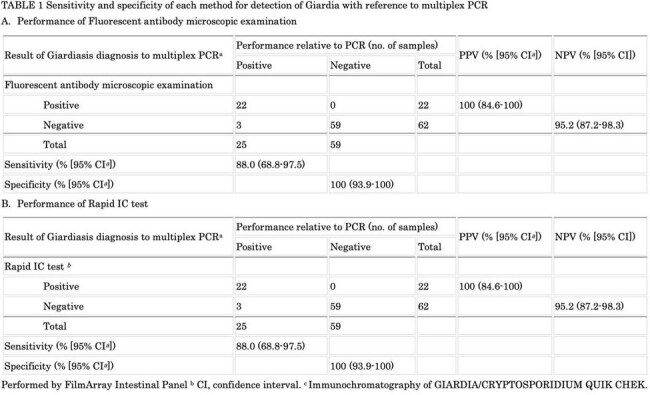 Figure 1
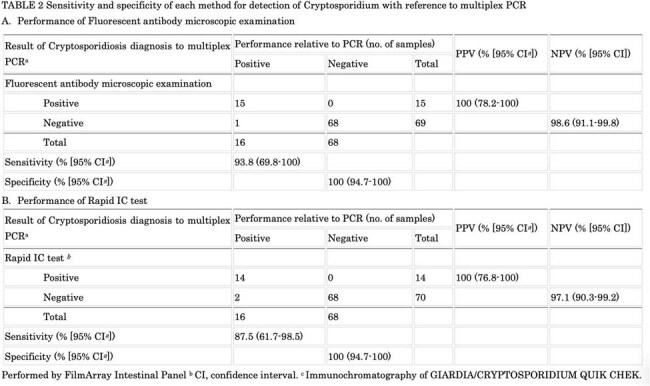 Figure 2
Peer Reviews
No public reviews on file for this paper yet. If you reviewed it on a platform where reviews are public (OpenReview, ICLR, NeurIPS, ICML), you can paste yours below so the community can read it here.
Videos
No videos yet. Explain this paper in a talk, walkthrough, or lecture? Add one.
Taxonomy
TopicsParasitic Infections and Diagnostics · Fungal Infections and Studies · Toxoplasma gondii Research Studies