P-1160. Hospital-Onset Bacteremia as a Surveillance Tool: A Comparative Analysis with CLABSI Rates
Xaviera Ortiz Soto, Jose Martinez, Kelly R Reveles, Lauren N Garza, Jose Cadena

TL;DR
This study compares two measures of hospital-acquired blood infections and finds they are not strongly correlated.
Contribution
It evaluates HOBSI as a potential alternative to CLABSI for tracking hospital infections.
Findings
There was a low, non-significant correlation between HOBSI and CLABSI rates (R=0.30; p=0.343).
HOBSI rates showed an increasing trend while CLABSI rates decreased during the study period.
Both HOBSI and CLABSI rates were low, with 91 and 14 cases respectively over the study period.
Abstract
Hospital-acquired infections (HAIs) are the most frequent cause of nosocomial adverse effects in the United States. In 2009, the Department of Health and Human Services developed an action plan to eliminate HAIs which includes monitoring the rates of six nosocomial infections including central line-associated bloodstream infections (CLABSIs). The focus on these measures has resulted in a decreased incidence of nosocomial blood stream infections, but the measures are labor-intensive, subject to ceiling effects, and do not reflect the full burden of hospital-acquired blood stream infections. Given these limitations, hospital-onset blood stream infection (HOBSI), defined as the growth of a recognized bacterial or fungal pathogen from a blood culture specimen collected on or after the fourth day of hospital admission, has been proposed as an alternate measure of nosocomial blood-stream…
Click any figure to enlarge with its caption.
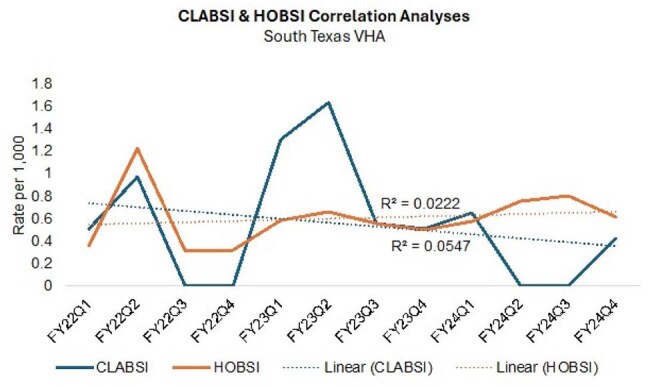 Figure 1
Peer Reviews
No public reviews on file for this paper yet. If you reviewed it on a platform where reviews are public (OpenReview, ICLR, NeurIPS, ICML), you can paste yours below so the community can read it here.
Videos
No videos yet. Explain this paper in a talk, walkthrough, or lecture? Add one.
Taxonomy
TopicsBacterial Identification and Susceptibility Testing · Nosocomial Infections in ICU · Neonatal and Maternal Infections