P-716. Limit of Detection and Inclusivity of a Research-Use-Only (RUO) Prototype of a Multiplexed Sample-to-Answer PCR System for the Identification of Vaginal Infections from Vaginal Swabs
Angela Clark, Brandon Hanberg, Ashley Hillman, Crystal Smith, Jessica Papenfuss, Craig Chandler, Robert Trauscht, J Nicholas Francis, Michael Vaughn, Justin Keener, Usha Spaulding, Margarita Rogatcheva

TL;DR
This paper evaluates a new rapid diagnostic test for identifying common vaginal infections using PCR technology, showing it can accurately detect key pathogens from vaginal swabs.
Contribution
The study presents a new RUO multiplexed PCR system for point-of-care detection of bacterial vaginosis, vulvovaginal candidiasis, and trichomoniasis with validated limit of detection and inclusivity.
Findings
The test achieved a limit of detection ranging from 4.19E+01 to 5.93E+03 copies/mL for BV analytes.
The system detected T. vaginalis at 5.75E-01 copies/mL in vaginal swab samples.
In silico analysis predicted 99.7% reactivity of panel assays with relevant pathogen sequences.
Abstract
Bacterial vaginosis (BV), vulvovaginal candidiasis (VVC), and trichomoniasis, caused by Trichomonas vaginalis, are prevalent, symptomatically similar conditions causing vaginal discharge, discomfort, and adverse reproductive outcomes, if left untreated. bioMérieux is developing the BIOFIRE® SPOTFIRE® Vaginitis (VG) Panel, a syndromic, molecular test designed for the point-of-care setting to test a vaginal swab (Vswab) in eNAT® media, providing rapid diagnosis (≤ 20 minutes) for BV, VVC (specification of six Candida species), and trichomoniasis. These study results detail the limit of detection (LoD) and reactivity of the RUO Panel assays. 95% LoD was determined for panel analytes using a dilution series of molecularly quantified strains in sample collection medium (eNAT) in the presence and absence of Vswab matrices. Ten unique Vswab samples were tested to evaluate the impact of…
Genes, proteins, chemicals, diseases, species, mutations and cell lines named across the full text — each resolved to its canonical identifier and authoritative record.
Click any figure to enlarge with its caption.
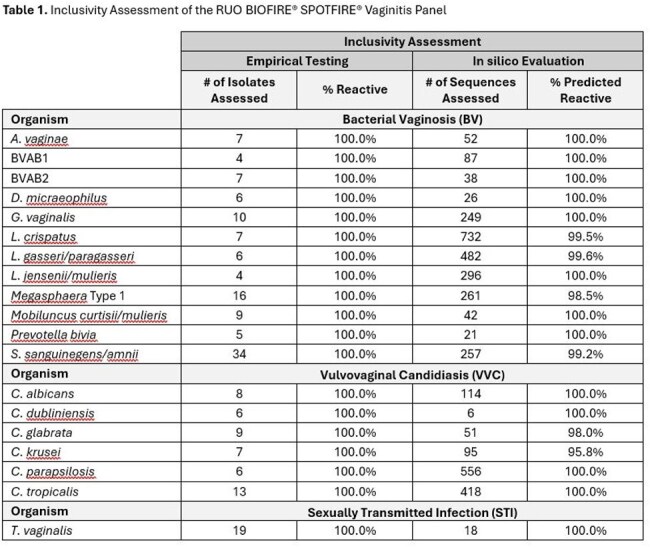 Figure 1
Peer Reviews
No public reviews on file for this paper yet. If you reviewed it on a platform where reviews are public (OpenReview, ICLR, NeurIPS, ICML), you can paste yours below so the community can read it here.
Videos
No videos yet. Explain this paper in a talk, walkthrough, or lecture? Add one.
Taxonomy
TopicsReproductive tract infections research · Bacterial Identification and Susceptibility Testing · Syphilis Diagnosis and Treatment